Computational Mathematics II
Comprehensive Solved Portal · 100% Exam Blueprint & Document Breakdown
⭐ Master Exam Blueprint (100% Aligned)
11 Long Topics + Exhaustive 2-Markers1. Random Variable & Types
Function mapping sample space outcomes to real numbers. Discrete: countable values (e.g. coin tosses). Continuous: infinite interval values (e.g. exact bulb lifespan).
2. Diagonally Dominant Matrix
Square matrix where $|a_{ii}| \ge \sum_{j \ne i} |a_{ij}|$ in every row. Guarantees Jacobi/Seidel convergence. Example: $\begin{bmatrix} 4 & 1 \\ 2 & 5 \end{bmatrix}$.
3. Convex Set (2 Applications)
Line segment between any two set points lies entirely within the set. Applications: Linear Programming feasibility regions, Game Theory strategy spaces.
4. Convex Function (2 Applications)
Line segment between two graph points lies above or on the graph ($f''(x) \ge 0$). Applications: Global optimization proofs, Machine Learning MSE loss minimization.
5. Regression Interpretation
Fits $y=a+bx$. Slope $b$ is rate of change (pressure rise per $1^\circ\text{C}$ temperature increase). Intercept $a$ is baseline value at $x=0$.
6. Central Limit Theorem (CLT)
Sampling distribution of sample mean $\bar{X}$ of size $n$ approaches normal distribution $N(\mu, \sigma^2/n)$ for $n \ge 30$, regardless of population distribution.
Every exam topic below features its complete mathematical methodology explanation alongside the fully worked out solution of its mapped syllabus problem.
1. First Order Non-Exact DE (Integrating Factor)
Mapped Question (Assignment 1 Q4): Solve $(x^2y^2+y)dx + (2x^3y-x)dy = 0$.
2. Second Order Non-Homogeneous DE
Mapped Question (Question Bank Vol 1): Find general solution of $y'' - 4y = e^{3x}$.
3. Singular Value Decomposition (SVD 3×3 / 2×3)
Mapped Question (Assignment 2 Q15): Find SVD of $A = \begin{bmatrix} 1 & 1 \\ 0 & 1 \\ -1 & 1 \end{bmatrix}$.
4. Lagrange Multiplier Constrained Extrema
Mapped Question (Question Bank Vol 1): Maximize $f(x,y) = xy$ subject to $x+y=10$.
5. Eigenvalue & Eigenvector (3×3 Characteristic Cubic)
Mapped Question (Assignment 2 Q11 matrix): Find characteristic equation for $A = \begin{bmatrix} 3 & 1 & 6 \\ -6 & 0 & -16 \\ 0 & 8 & -17 \end{bmatrix}$.
6. Linear Regression (Least Squares Normal Equations)
Mapped Question (Question Bank Vol 2): Fit straight line $y=a+bx$ to $(1,3), (2,5), (3,7)$.
7. Gauss–Jacobi Iterative Solver
Mapped Question (Assignment 2 Q17): Solve $20x+y-2z=17, \quad 3x+20y-z=-18, \quad 2x-3y+20z=25$. Start $(0,0,0)$.
8. Gauss–Seidel Iterative Solver
Mapped Question (Assignment 2 Q13): Solve $45x_1+2x_2+3x_3=58, \quad -3x_1+22x_2+2x_3=47, \quad 5x_1+x_2+20x_3=67$. Start $(0,0,0)$.
9. Continuous Random Variable $kx^2$ on $[0,5]$
Mapped Question (Question Bank Vol 1): Given PDF $f(x)=kx^2$ for $0 \le x \le 5$, find $k$, Mean, Variance, SD.
10. Binomial Distribution (No MGF, PDF Only)
Mapped Question (Assignment 3 Q5): Binomial distribution with Mean $=2.4$, Variance $=1.44$. Find $P(X \ge 5)$ and $P(1 < X \le 4)$.
11. Exponential Distribution Derivations
Mapped Question (Question Bank Vol 1 Derivations): Derive Mean, MGF, Variance, and solve bulb problem (Mean $=100$ hrs, fails before 50 hrs).
💡 Exhaustive Master Bank from All Question Banks
Below is the complete collection of all 33 short definition questions and 2-mark solved problems from Vol 1, Vol 2, and course assignments. Memorize these exact definitions and steps to guarantee full marks.1. Order & Degree of DE
Q: Find order
and degree of $(d^2y/dx^2)^3 + 4(dy/dx)^4 + y = \sin
x$.
Solution: Highest order derivative
is $d^2y/dx^2$ (Order = 2). Its power is 3 (Degree = 3).
Answer: Order = 2, Degree = 3.
2. Linear vs Non-Linear DE
Linear: Dependent variable $y$ and derivatives appear in first power only, without products $y \cdot y'$. Non-Linear: Contains higher powers, products, or transcendental functions of $y$ (e.g. $\sin y$).
3. Exact DE Condition
An equation $M dx + N dy = 0$ is exact if it is the total differential $du=0$ of a function $u(x,y)$. Necessary and sufficient condition: $\frac{\partial M}{\partial y} = \frac{\partial N}{\partial x}$.
4. Integrating Factor (I.F.)
A non-zero function $\mu(x,y)$ by which a non-exact differential equation is multiplied to convert it into an exact differential equation.
5. IVP vs BVP
Initial Value Problem (IVP): Auxiliary conditions specified at a *single* point $x_0$. Boundary Value Problem (BVP): Conditions specified at *two or more distinct* boundary points.
6. C.F. vs P.I.
Complementary Function (C.F.): General solution of homogeneous equation $f(D)y=0$ containing arbitrary constants. Particular Integral (P.I.): Specific solution to $f(D)y=X(x)$ containing no arbitrary constants.
7. Solve Linear DE (2 Marks)
Q: Solve $dy/dx
+ (2/x)y = x^2$.
Solution: $P=2/x,
Q=x^2$. $I.F. = e^{\int 2/x dx} = x^2$. $y x^2 = \int x^4 dx
= x^5/5 + C$. Answer: $y = x^3/5 + C/x^2$.
8. Solve Exact DE (2 Marks)
Q: Solve
$(2xy+3)dx + (x^2-1)dy = 0$.
Solution:
$M_y=2x, N_x=2x$ (Exact). $\int (2xy+3)dx - \int 1 dy = C$.
Answer: $x^2y + 3x - y = C$.
9. Solve Homogeneous DE
Q: Solve
$(x^2+y^2)dx - 2xy dy = 0$.
Solution:
Put $y=vx, dy/dx=v+x(dv/dx)$. Separate variables and
integrate. Answer: $x^2 - y^2 = Cx$.
10. Solve Separable DE
Q: Solve $dy/dx
= (x e^x)/y$.
Solution: $y dy = x e^x dx
\implies y^2/2 = x e^x - e^x + C$. Answer: $y^2 =
2e^x(x-1) + K$.
11. Solve Bernoulli DE
Q: Solve $dy/dx
+ y = y^2$.
Solution: Put $v=y^{-1}$. DE
becomes linear $dv/dx - v = -1$. $I.F.=e^{-x}$.
Answer: $y = 1/(1+C e^x)$.
12. Solve IVP (2 Marks)
Q: Solve $dy/dx
= -2xy, \quad y(0)=5$.
Solution: $dy/y =
-2x dx \implies \ln|y| = -x^2+C \implies y=C e^{-x^2}$.
$y(0)=5 \implies C=5$. Answer: $y =
5e^{-x^2}$.
13. Solve BVP (2 Marks)
Q: Solve
$y''+4y=0, \quad y(0)=0,
y(\pi/4)=2$.
Solution: $y = C_1 \cos(2x)
+ C_2 \sin(2x)$. $y(0)=0 \implies C_1=0$. $y(\pi/4)=2
\implies C_2=2$. Answer: $y = 2\sin(2x)$.
14. Solve 2nd Order Homogeneous
Q: Solve
$d^2y/dx^2 - 5(dy/dx) + 6y =
0$.
Solution: Aux equation $m^2-5m+6=0
\implies (m-2)(m-3)=0 \implies m=2,3$. Answer: $y =
C_1 e^{2x} + C_2 e^{3x}$.
15. Absolute, Relative, % Error
Absolute: $E_a = |X_{\text{true}} - X_{\text{approx}}|$. Relative: $E_r = E_a / |X_{\text{true}}|$. Percentage: $E_p = E_r \times 100\%$.
16. Bisection Method (2 Marks)
Q: Root of
$x^3-x-1=0, [1,2]$, 2
iterations.
Solution: $f(1)=-1, f(2)=5$.
$x_1=1.5, f(1.5)=0.875$. $x_2=(1+1.5)/2=1.25$.
Answer: $x \approx 1.25$.
17. Secant Method (2 Marks)
Q: Root of
$x^2-4=0, x_0=1, x_1=3$, 1
iter.
Solution: $f(1)=-3, f(3)=5$. $x_2
= 3 - 5\frac{3-1}{5-(-3)} = 3 - 10/8 = 1.75$.
Answer: $x_2 = 1.75$.
18. Newton Raphson (2 Marks)
Q: Solve
$x^3-2x-5=0, x_0=2$, 1 iter.
Solution:
$f(2)=-1, f'(2)=10$. $x_1 = 2 - (-1)/10 = 2.1$.
Answer: $x_1 = 2.1$.
19. Regula Falsi (2 Marks)
Q: Root of
$x^2-3=0, [1,2]$, 1 iter.
Solution:
$f(1)=-2, f(2)=1$. $x_1 = \frac{1(1)-2(-2)}{1-(-2)} =
\frac{5}{3} \approx 1.666$. Answer: $x_1 \approx
1.666$.
20. LU Decomposition (2 Marks)
Q: LU for $A =
[[2,3],[4,7]]$.
Solution: $U_{11}=2,
U_{12}=3$. $L_{21}(2)=4 \implies L_{21}=2$. $2(3)+U_{22}=7
\implies U_{22}=1$. Answer: $L=[[1,0],[2,1]],
U=[[2,3],[0,1]]$.
21. SVD Analytical Steps
Compute $A^T A$ and $AA^T$. Find eigenvalues and orthonormal eigenvectors of $A^T A$ for columns of $V$. Singular values $\sigma_i=\sqrt{\lambda_i}$ form $\Sigma$. Columns of $U$ are $u_i = (1/\sigma_i)A v_i$. Assemble $A=U\Sigma V^T$.
22. Gauss Seidel (2 Marks)
Q: Solve
$4x+y=5, x+3y=4$, start (0,0).
Solution:
$x_1=(5-0)/4=1.25$. Immediately use $x_1$:
$y_1=(4-1.25)/3=0.916$. Answer: $x_1=1.25,
y_1=0.916$.
23. Gauss Jacobi (2 Marks)
Q: Solve
$4x+y=5, x+3y=4$, start (0,0).
Solution:
$x_1=(5-0)/4=1.25$. Uses OLD $x_0=0$: $y_1=(4-0)/3=1.333$.
Answer: $x_1=1.25, y_1=1.333$.
24. Cholesky Decomposition
Q: Cholesky for
$A = [[4,2],[2,10]]$.
Solution:
$L_{11}^2=4 \implies L_{11}=2$. $2L_{21}=2 \implies
L_{21}=1$. $1^2+L_{22}^2=10 \implies L_{22}=3$.
Answer: $L=[[2,0],[1,3]]$.
25. Forward Difference Table
Q: Forward
difference table for $y=x^2,
x=1,2,3$.
Solution: $y=[1,4,9]$. First
diff $\Delta y = [4-1, 9-4] = [3,5]$. Second diff $\Delta^2
y = [5-3] = [2]$. Answer: $\Delta y=[3,5], \Delta^2
y=[2]$.
26. Discrete vs Continuous RV
Discrete: Takes countable distinct values (e.g. number of heads). Continuous: Takes uncountably infinite values within an interval (e.g. exact height or weight).
27. Mean, Var, SD Calculation
Q: $P(0)=0.2,
P(1)=0.5, P(2)=0.3$.
Solution: Mean
$=0(0.2)+1(0.5)+2(0.3)=1.1$. $E[X^2]=0+0.5+4(0.3)=1.7$. Var
$=1.7-1.1^2=0.49$. SD $=\sqrt{0.49}=0.7$. Answer:
Mean=1.1, Var=0.49, SD=0.7.
28. Bernoulli Distribution PMF
Q: Give PMF and
Mean for Bernoulli
distribution.
Solution: PMF
$P(X=x)=p^x(1-p)^{1-x}$ for $x \in \{0,1\}$. Mean $E[X]=p$.
Variance $=p(1-p)$.
29. Binomial Probability (2M)
Q: Fair coin
tossed 4 times, exactly 2
heads.
Solution: $n=4, p=0.5, r=2$.
$P(X=2) = \binom{4}{2}(0.5)^2(0.5)^2 = 6(0.0625) = 3/8 =
0.375$. Answer: $0.375$.
30. Poisson Probability (2M)
Q: Call center 3
calls/min, exactly 1 call.
Solution:
$\lambda=3$. $P(X=1) = \frac{e^{-3}3^1}{1!} = 3 e^{-3}
\approx 3/20.085 \approx 0.149$. Answer: $\approx
0.149$.
31. Exponential Probability
Q: Bulb mean
$=100$ hrs, fails before 50
hrs.
Solution: $\lambda=1/100=0.01$.
$P(X < 50)=1 - e^{-0.01(50)}=1 - e^{-0.5} \approx 0.3935$.
Answer: $39.35\%$.
32. Convex Set & Function
Convex Set: Line segment connecting any two set points lies entirely within the set. Convex Function: Line segment between any two graph points lies above or on the graph ($f''(x) \ge 0$).
33. Optimization Max/Min
Q: Find max/min
of $f(x)=x^2-6x+8$.
Solution:
$f'(x)=2x-6=0 \implies x=3$. $f''(x)=2 > 0$ (Local Min). Min
value $f(3)=9-18+8=-1$. Answer: Min is -1 at
x=3.
📝 Assignment 1: Differential Equation Modelling
All 13 Questions Fully SolvedQ: Solve $\sin x \, dx + y \, dy = 0, \quad y(0)=1$.
• Separate variables: $y \, dy = -\sin x \, dx$.
• Integrate both sides: $\int y \, dy = -\int \sin x \, dx \implies \frac{y^2}{2} = \cos x + C$.
• Apply initial condition $y(0)=1$: $\frac{1^2}{2} = \cos(0) + C \implies \frac{1}{2} = 1 + C \implies C = -\frac{1}{2}$.
• Substitute $C$: $\frac{y^2}{2} = \cos x - \frac{1}{2} \implies y^2 = 2\cos x - 1$.
Q: Solve $(3x^2+2xy^2)dx + (2x^2y)dy = 0, \quad y(2)=-3$.
• Let $M = 3x^2+2xy^2$ and $N = 2x^2y$.
• Exact check: $\frac{\partial M}{\partial y} = 4xy, \quad \frac{\partial N}{\partial x} = 4xy$. Since equal, DE is exact.
• Solution formula: $\int M \, dx + \int (\text{terms of } N \text{ without } x)dy = C$.
• $\int (3x^2+2xy^2)dx = x^3 + x^2y^2$. Terms of $N$ without $x$: None.
• General solution: $x^3 + x^2y^2 = C$.
• Apply condition $x=2, y=-3$: $2^3 + (2^2)(-3)^2 = 8 + 4(9) = 8 + 36 = 44 \implies C=44$.
Q: Solve $\frac{y}{x^2+1} + \frac{y'}{x} = 0$.
• Rewrite $y'$ as $\frac{dy}{dx}$: $\frac{1}{x}\frac{dy}{dx} = -\frac{y}{x^2+1}$.
• Separate variables: $\frac{dy}{y} = -\frac{x}{x^2+1}dx$.
• Integrate: $\int \frac{1}{y}dy = -\frac{1}{2}\int \frac{2x}{x^2+1}dx \implies \ln|y| = -\frac{1}{2}\ln(x^2+1) + C$.
• Exponentiate: $y = e^C \cdot (x^2+1)^{-1/2} = \frac{K}{\sqrt{x^2+1}}$.
Q: Solve $(x^2y^2+y)dx + (2x^3y-x)dy = 0$.
• $M = x^2y^2+y, \quad N = 2x^3y-x$.
• $\frac{\partial M}{\partial y} = 2x^2y+1, \quad \frac{\partial N}{\partial x} = 6x^2y-1$. Non-exact.
• Compute $\frac{M_y - N_x}{N} = \frac{(2x^2y+1) - (6x^2y-1)}{2x^3y-x} = \frac{-4x^2y+2}{x(2x^2y-1)} = -\frac{2}{x}$.
• $I.F. = e^{\int -2/x \, dx} = x^{-2} = \frac{1}{x^2}$.
• Multiply DE by $\frac{1}{x^2}$: $\left(y^2 + \frac{y}{x^2}\right)dx + \left(2xy - \frac{1}{x}\right)dy = 0$. Exact.
• $\int \left(y^2 + \frac{y}{x^2}\right)dx = xy^2 - \frac{y}{x} = C$.
Q: Solve $y' - \frac{1}{x}y = x^3, \quad x>0$.
• Standard form: $\frac{dy}{dx} + P y = Q \implies P = -\frac{1}{x}, Q = x^3$.
• $I.F. = e^{\int -1/x \, dx} = e^{-\ln x} = x^{-1} = \frac{1}{x}$.
• General solution: $y \cdot (I.F.) = \int Q \cdot (I.F.) dx + C$.
• $y\left(\frac{1}{x}\right) = \int x^3 \left(\frac{1}{x}\right)dx = \int x^2 dx = \frac{x^3}{3} + C$.
Q: Solve $\frac{dy}{dx} + \frac{y}{x} = y^2$.
• Divide by $y^2$: $y^{-2}\frac{dy}{dx} + \frac{1}{x}y^{-1} = 1$.
• Substitution: $v = y^{-1} \implies \frac{dv}{dx} = -y^{-2}\frac{dy}{dx}$. DE becomes: $-\frac{dv}{dx} + \frac{v}{x} = 1 \implies \frac{dv}{dx} - \frac{v}{x} = -1$.
• $I.F. = e^{\int -1/x \, dx} = \frac{1}{x}$.
• Solution for $v$: $v\left(\frac{1}{x}\right) = \int -1\left(\frac{1}{x}\right)dx = -\ln x + C \implies v = x(C - \ln x)$.
• Substitute back $y = \frac{1}{v}$.
Q: Solve $\frac{dy}{dx} + \frac{1}{3}y = e^x y^4$.
• Divide by $y^4$: $y^{-4}\frac{dy}{dx} + \frac{1}{3}y^{-3} = e^x$.
• Substitution: $v = y^{-3} \implies \frac{dv}{dx} = -3y^{-4}\frac{dy}{dx} \implies \frac{dv}{dx} - v = -3e^x$.
• $I.F. = e^{\int -1 \, dx} = e^{-x}$.
• Solution for $v$: $v e^{-x} = \int -3e^x (e^{-x})dx = \int -3 dx = -3x + C \implies v = e^x(C - 3x)$.
• Substitute back $y = v^{-1/3}$.
Q: Solve $x\frac{dy}{dx} + y = xy^3$.
• Divide by $x y^3$: $\frac{y^{-3}}{x}\frac{dy}{dx} + \frac{y^{-2}}{x} = 1 \implies y^{-3}\frac{dy}{dx} + \frac{y^{-2}}{x} = 1$.
• Put $v = y^{-2} \implies \frac{dv}{dx} = -2y^{-3}\frac{dy}{dx} \implies \frac{dv}{dx} - \frac{2}{x}v = -2$.
• $I.F. = e^{\int -2/x \, dx} = \frac{1}{x^2}$.
• $v\left(\frac{1}{x^2}\right) = \int -2\left(\frac{1}{x^2}\right)dx = \frac{2}{x} + C \implies v = 2x + Cx^2$.
Q: Solve $\frac{dy}{dx} + \frac{2}{x}y = -x^2 \cos x \cdot y^2$.
• Divide by $y^2$: $y^{-2}\frac{dy}{dx} + \frac{2}{x}y^{-1} = -x^2 \cos x$.
• Put $v = y^{-1} \implies \frac{dv}{dx} - \frac{2}{x}v = x^2 \cos x$.
• $I.F. = e^{\int -2/x \, dx} = \frac{1}{x^2}$.
• $v\left(\frac{1}{x^2}\right) = \int (x^2 \cos x)\left(\frac{1}{x^2}\right)dx = \int \cos x \, dx = \sin x + C \implies v = x^2(\sin x + C)$.
Q: Solve $3y'' + y' - y = 0$.
• Auxiliary equation: $3m^2 + m - 1 = 0$.
• Quadratic formula: $m = \frac{-1 \pm \sqrt{1 - 4(3)(-1)}}{6} = \frac{-1 \pm \sqrt{13}}{6}$.
• Real and distinct roots.
Q: Solve $y'' - 6y' + 13y = 0$.
• Auxiliary equation: $m^2 - 6m + 13 = 0$.
• Roots: $m = \frac{6 \pm \sqrt{36 - 52}}{2} = \frac{6 \pm \sqrt{-16}}{2} = 3 \pm 2i$. Complex roots $\alpha \pm i\beta$.
Q: Solve $y'' + y = 0, \quad y(0)=2, y'(0)=3$.
• Auxiliary equation: $m^2 + 1 = 0 \implies m = \pm i$.
• General solution: $y = C_1 \cos x + C_2 \sin x$. Derivative: $y' = -C_1 \sin x + C_2 \cos x$.
• Put $y(0)=2 \implies C_1 \cos(0) + C_2 \sin(0) = 2 \implies C_1 = 2$.
• Put $y'(0)=3 \implies -C_1 \sin(0) + C_2 \cos(0) = 3 \implies C_2 = 3$.
Q: Solve $y'' + 2y' + y = 0, \quad y(0)=1, y(1)=3$.
• Auxiliary equation: $m^2 + 2m + 1 = 0 \implies (m+1)^2 = 0 \implies m = -1, -1$ (Repeated roots).
• General solution: $y = (C_1 + C_2 x)e^{-x}$.
• Put $y(0)=1 \implies (C_1 + 0)e^0 = 1 \implies C_1 = 1$. Solution becomes $y = (1 + C_2 x)e^{-x}$.
• Put $y(1)=3 \implies (1 + C_2)e^{-1} = 3 \implies 1 + C_2 = 3e \implies C_2 = 3e - 1$.
📊 Assignment 2: Numerical Methods
All 18 Questions Fully SolvedQ: Show that $f(x) = x^3 + 4x^2 - 10 = 0$ has a root in $[1,2]$.
• Evaluate endpoints: $f(1) = 1 + 4 - 10 = -5$ (Negative).
• $f(2) = 8 + 16 - 10 = 14$ (Positive).
• Since $f(x)$ is continuous and changes sign across $[1,2]$, by Intermediate Value Theorem, a root exists.
Q: Solve $x^3 - 1.1x^2 + 4x - 4.4 = 0$ correct to 2 sig figs.
• Notice factoring: $x^2(x - 1.1) + 4(x - 1.1) = (x^2+4)(x - 1.1) = 0$. The exact real root is $x=1.1$. Bisection converges precisely to this value.
Q: Solve $x e^{0.5x} + 11.2x = 10x + 5, \quad x_i=1.6, x_{i-1}=10$ (3 iterations).
• $f(x) = x e^{0.5x} + 1.2x - 5$. Iterations formula: $x_{k+1} = x_k - f(x_k)\frac{x_k - x_{k-1}}{f(x_k) - f(x_{k-1})}$.
Q: Solve $3e^{-x} - 3x = 0, \quad [0,1], x_0=0, x_1=1$ (2 iterations).
• $f(0)=3, f(1) = 3e^{-1}-3 = -1.896$.
• Iteration 1: $x_2 = 1 - (-1.896)\frac{1 - 0}{-1.896 - 3} \approx 0.6127$.
• Iteration 2 yields $x_3 \approx 0.567$.
Q: Find $x_2$ for $f(x) = x^3 - 7x^2 + 8x - 3, \quad x_0=5$.
• $f'(x) = 3x^2 - 14x + 8$. $f(5) = 125 - 175 + 40 - 3 = -13, \quad f'(5) = 75 - 70 + 8 = 13$.
• Iter 1: $x_1 = 5 - (-13)/13 = 6$.
• $f(6) = 216 - 252 + 48 - 3 = 9, \quad f'(6) = 108 - 84 + 8 = 32$.
• Iter 2: $x_2 = 6 - 9/32 = 6 - 0.28125 = 5.71875$.
Q: Solve $x^4 - 5x^3 + 9x + 3 = 0, \quad [4,6]$.
• Start $x_0=5$. Formula $x_{k+1} = x_k - \frac{f(x_k)}{f'(x_k)}$. Iterations converge to 6 decimal places.
Q: Solve $2x^2 + 5 = e^x, \quad [3,4]$.
• $f(x) = e^x - 2x^2 - 5, \quad f'(x) = e^x - 4x$. Start $x_0=3.5$.
Q: Solve $2x^3 - 11.7x^2 + 17.7x - 5 = 0, \quad x_0=3$ (3 iterations).
• Rearrange to $x = g(x)$. Iterating yields $x_3 \approx 3.56$.
Q: Solve $x^3 - x - 1 = 0, \quad x_0=1.5$ (4 iterations).
• Rearrange $x = \sqrt[3]{x+1}$. Iterations: $x_1 \approx 1.357, x_2 \approx 1.331, x_3 \approx 1.326, x_4 \approx 1.324$.
Q: Find LU for $\begin{bmatrix} 3 & 1 \\ -6 & -4 \end{bmatrix}$.
• $L = \begin{bmatrix} 1 & 0 \\ l_{21} & 1 \end{bmatrix}, \quad U = \begin{bmatrix} u_{11} & u_{12} \\ 0 & u_{22} \end{bmatrix}$.
• $u_{11}=3, u_{12}=1$. $l_{21}(3) = -6 \implies l_{21} = -2$. $l_{21}u_{12} + u_{22} = -4 \implies -2 + u_{22} = -4 \implies u_{22} = -2$.
Q: Find LU for $\begin{bmatrix} 3 & 1 & 6 \\ -6 & 0 & -16 \\ 0 & 8 & -17 \end{bmatrix}$.
• Equating $LU = A$:
Q: Solve system via Cholesky: $4x_1+2x_2+14x_3=14, \quad 2x_1+17x_2-5x_3=-101, \quad 14x_1-5x_2+83x_3=155$.
• Factor $A = LL^T$. Forward solve $Ly=b$, backward solve $L^T x = y$.
Q: Solve $45x_1+2x_2+3x_3=58, \quad -3x_1+22x_2+2x_3=47, \quad 5x_1+x_2+20x_3=67$.
• Diagonally dominant. Iterating converges to exact integers.
Q: Solve $27x+6y-z=85, \quad 6x+15y+2z=72, \quad x+y+54z=110$.
• Diagonally dominant. Iterations converge rapidly.
Q: Find SVD for $A = \begin{bmatrix} 1 & 1 \\ 0 & 1 \\ -1 & 1 \end{bmatrix}$.
• Solved fully in Master Blueprint Tab (Topic 3). $A = U\Sigma V^T$.
Q: Compute SVD for $A = \begin{bmatrix} 2 & 1 & 4 \\ -1 & 2 & -2 \end{bmatrix}$.
• Compute $AA^T = \begin{bmatrix} 21 & -8 \\ -8 & 9 \end{bmatrix}$. Find eigenvalues and assemble $U, \Sigma, V^T$.
Q: Solve $20x+y-2z=17, \quad 3x+20y-z=-18, \quad 2x-3y+20z=25$.
• Diagonally dominant. Iterating with OLD values converges to:
Q: Solve 4-variable system via Jacobi (4 iterations). Start $(0,0,0,0)$.
• Use old values across each step. Iteration 4 yields values approaching exact solution.
🎲 Assignment 3: Probability & Distributions
All 11 Questions Fully SolvedQ: $P(X=1) = 2P(X=2)$. Find $P(X=0)$, Mean, Variance.
• $\lambda e^{-\lambda} = 2 \frac{\lambda^2 e^{-\lambda}}{2} \implies \lambda = 1$. Mean=1, Var=1, $P(0)=e^{-1} \approx 0.368$.
Q: $n=6, \quad P(X=4) = P(X=2)$. Find $p$.
• $\binom{6}{4} p^4 q^2 = \binom{6}{2} p^2 q^4 \implies 15 p^4 q^2 = 15 p^2 q^4 \implies p^2 = q^2 \implies p = q = 0.5$.
Q: $n=5$, prob of 1 and 2 successes are $0.4096$ and $0.2048$. Find $p$.
• $\frac{P(X=2)}{P(X=1)} = \frac{\binom{5}{2}p^2 q^3}{\binom{5}{1}p q^4} = \frac{10p}{5q} = \frac{2p}{q} = \frac{0.2048}{0.4096} = 0.5 \implies 2p = 0.5(1-p) \implies 2.5p = 0.5 \implies p=0.2$.
Q: Poisson $P(X=1)=P(X=2)$. Find $P(X=4)$.
• $\lambda = \lambda^2 / 2 \implies \lambda = 2$. $P(4) = \frac{e^{-2} 2^4}{4!} = \frac{16 e^{-2}}{24} = \frac{2}{3}e^{-2}$.
Q: Mean=2.4, Var=1.44. Find $P(X \ge 5)$ and $P(1 < X \le 4)$.
• Fully solved in Master Blueprint Tab (Topic 10). $n=6, p=0.4$. $P(X \ge 5) = 0.04096, \quad P(1 < X \le 4)=0.72576$.
Q: Independent Poisson $X, Y$. $P(X=1)=P(X=2)$ and $P(Y=2)=P(Y=3)$. Find Var$(X-2Y)$.
• For $X$: $\lambda_X = 2 \implies \text{Var}(X)=2$. For $Y$: $\frac{\lambda_Y^2}{2} = \frac{\lambda_Y^3}{6} \implies \lambda_Y = 3 \implies \text{Var}(Y)=3$.
• $\text{Var}(X-2Y) = \text{Var}(X) + (-2)^2\text{Var}(Y) = 2 + 4(3) = 14$.
Q: $P(X=2) = 9P(X=4) + 90P(X=6)$. Find $\lambda$ and Mean.
• Expand terms and divide by $\frac{e^{-\lambda}\lambda^2}{2}$. Solves quadratic in $\lambda^2 \implies \lambda = 1$.
Q: 10 coins thrown. Probability of at least 7 heads.
• $P(X \ge 7) = [ \binom{10}{7} + \binom{10}{8} + \binom{10}{9} + \binom{10}{10} ] / 2^{10} = [120+45+10+1]/1024 = 176/1024 = 11/64 \approx 0.172$.
Q: Comment: "Mean of binomial is 3 and variance is 4."
• Mathematically impossible since Var $= npq < np=\text{Mean}$.
Q: Mean=4, Var=4/3. Find $P(X \ge 1)$.
• $q = \frac{4/3}{4} = \frac{1}{3} \implies p = \frac{2}{3} \implies n=6$. $P(X \ge 1) = 1 - P(0) = 1 - (1/3)^6 = 1 - 1/729 = 728/729$.
Q: $P(X=2) = \frac{2}{3}P(X=1)$. Find $P(X=0)$.
• $\frac{\lambda^2}{2} = \frac{2}{3}\lambda \implies \lambda = \frac{4}{3}$. $P(0) = e^{-4/3} \approx 0.2636$.
📚 Question Bank Vol. 1 Solutions
All 33 Questions Fully Solved & DocumentedQ: Determine the order and degree of: $(d^2y/dx^2)^3 + 4(dy/dx)^4 + y = \sin x$.
• Step 1: Identify highest derivative. The highest order derivative is $\frac{d^2y}{dx^2}$.
• Step 2: Order is the highest derivative present (2).
• Step 3: Degree is the highest power of highest order derivative (3).
Q: Solve the linear differential equation: $\frac{dy}{dx} + \frac{2}{x}y = x^2$.
• Step 1: Standard form $\frac{dy}{dx} + Py = Q$ where $P = 2/x, Q = x^2$.
• Step 2: $I.F. = e^{\int (2/x)dx} = e^{2\ln x} = x^2$.
• Step 3: $y \cdot (I.F.) = \int Q \cdot (I.F.) dx + C \implies y x^2 = \int x^4 dx = \frac{x^5}{5} + C$.
Q: Solve the exact equation: $(2xy+3)dx + (x^2-1)dy = 0$.
• Step 1: Let $M = 2xy+3, N = x^2-1$. $\frac{\partial M}{\partial y} = 2x, \frac{\partial N}{\partial x} = 2x$ (Exact).
• Step 2: $\int M dx = \int (2xy+3)dx = x^2y + 3x$.
• Step 3: $\int (\text{terms in } N \text{ without } x)dy = \int (-1)dy = -y$.
Q: Solve the homogeneous equation: $(x^2+y^2)dx - 2xy \, dy = 0$.
• Step 1: Rewrite $\frac{dy}{dx} = \frac{x^2+y^2}{2xy}$. Put $y=vx, \frac{dy}{dx} = v + x\frac{dv}{dx}$.
• Step 2: $v + x\frac{dv}{dx} = \frac{1+v^2}{2v} \implies x\frac{dv}{dx} = \frac{1-v^2}{2v}$.
• Step 3: $\int \frac{2v}{1-v^2}dv = \int \frac{1}{x}dx \implies -\ln(1-v^2) = \ln(Cx) \implies 1 - \left(\frac{y}{x}\right)^2 = \frac{C}{x}$.
Q: Solve the separable equation: $\frac{dy}{dx} = \frac{x e^x}{y}$.
• Step 1: Separate variables: $y \, dy = x e^x dx$.
• Step 2: Integrate by parts on RHS ($u=x, dv=e^x dx$): $\frac{y^2}{2} = x e^x - e^x + C$.
Q: Solve Bernoulli's equation: $\frac{dy}{dx} + y = y^2$.
• Step 1: Divide by $y^2$: $y^{-2}\frac{dy}{dx} + y^{-1} = 1$. Put $v=y^{-1} \implies \frac{dv}{dx} - v = -1$.
• Step 2: $I.F. = e^{-x} \implies v e^{-x} = \int -e^{-x}dx = e^{-x}+C \implies v = 1 + C e^x$.
Q: Solve IVP: $\frac{dy}{dx} = -2xy, \quad y(0)=5$.
• Step 1: $\frac{dy}{y} = -2x dx \implies \ln|y| = -x^2+C \implies y = C e^{-x^2}$.
• Step 2: $y(0)=5 \implies C=5$.
Q: Solve BVP: $y''+4y=0, \quad y(0)=0, y(\pi/4)=2$.
• Step 1: Auxiliary equation $m^2+4=0 \implies m=\pm 2i$. Solution $y = C_1 \cos(2x) + C_2 \sin(2x)$.
• Step 2: $y(0)=0 \implies C_1=0$. $y(\pi/4)=2 \implies C_2 \sin(\pi/2) = 2 \implies C_2=2$.
Q: Solve: $\frac{d^2y}{dx^2} - 5\frac{dy}{dx} + 6y = 0$.
• Step 1: Auxiliary equation $m^2-5m+6=0 \implies (m-2)(m-3)=0 \implies m=2,3$.
Q: Find general solution of $y'' - 4y = e^{3x}$.
• Step 1: C.F. for $m^2-4=0 \implies C_1 e^{2x} + C_2 e^{-2x}$.
• Step 2: P.I. $= \frac{1}{3^2-4}e^{3x} = \frac{1}{5}e^{3x}$.
Q: Define Absolute, Relative, and Percentage Error.
• Absolute Error $E_a = |X_{\text{true}} - X_{\text{approx}}|$.
• Relative Error $E_r = E_a / |X_{\text{true}}|$.
• Percentage Error $E_p = E_r \times 100\%$.
Q: Root of $x^3-x-1=0, [1,2]$, 2 iterations.
• Step 1: $f(1)=-1, f(2)=5$. Midpoint $x_1=1.5, f(1.5)=0.875$.
• Step 2: Root in $[1, 1.5]$. $x_2 = (1+1.5)/2 = 1.25$.
Q: Root of $x^2-4=0, x_0=1, x_1=3$, 1 iteration.
• Step 1: $f(1)=-3, f(3)=5$. $x_2 = 3 - 5\frac{3-1}{5-(-3)} = 3 - 10/8 = 1.75$.
Q: Solve $x^3-2x-5=0$ near $x_0=2$, 1 iteration.
• Step 1: $f(2)=-1, f'(2)=10$. $x_1 = 2 - (-1)/10 = 2.1$.
Q: Find root of $x^2-3=0$ in $[1,2]$, 1 iteration.
• Step 1: $f(1)=-2, f(2)=1$. $x_1 = \frac{1(1)-2(-2)}{1-(-2)} = \frac{5}{3} \approx 1.666$.
Q: Decompose matrix $A = \begin{bmatrix} 2 & 3 \\ 4 & 7 \end{bmatrix}$ into L and U.
• Step 1: $U_{11}=2, U_{12}=3$. $L_{21}(2)=4 \implies L_{21}=2$. $2(3)+U_{22}=7 \implies U_{22}=1$.
Q: Outline analytical steps to find SVD of matrix A.
• Compute $A^T A$ and $AA^T$. Find eigenvalues $\lambda_i$ and singular values $\sigma_i = \sqrt{\lambda_i}$. Assemble orthonormal eigenvectors into $V$ and $U$.
Q: Solve $4x+y=5, x+3y=4$, start (0,0), 1 iteration.
• Step 1: $x_1 = (5-0)/4 = 1.25$. Immediately use $x_1$: $y_1 = (4-1.25)/3 = 0.916$.
Q: Solve $4x+y=5, x+3y=4$, start (0,0), 1 iteration.
• Step 1: $x_1 = (5-0)/4 = 1.25$. Uses OLD $x_0=0$: $y_1 = (4-0)/3 = 1.333$.
Q: Find Cholesky decomposition of $A = \begin{bmatrix} 4 & 2 \\ 2 & 10 \end{bmatrix}$.
• $L_{11}^2=4 \implies L_{11}=2$. $2L_{21}=2 \implies L_{21}=1$. $1^2+L_{22}^2=10 \implies L_{22}=3$.
Q: Construct forward difference table for $y=x^2$ for $x=1,2,3$.
• $y=[1,4,9]$. First differences $\Delta y = [3,5]$. Second difference $\Delta^2 y = [2]$.
Q: State key difference between Discrete and Continuous Random Variables.
• Discrete takes countable distinct values. Continuous takes infinite interval values.
Q: Given $P(0)=0.2, P(1)=0.5, P(2)=0.3$. Find Mean, Var, SD.
• Mean $= 0(0.2)+1(0.5)+2(0.3) = 1.1$. $E[X^2] = 1.7$. Var $=1.7-1.1^2=0.49$. SD $=0.7$.
Q: Define Central Limit Theorem.
• Sample means approach normal distribution $N(\mu, \sigma^2/n)$ for $n \ge 30$.
Q: PMF and Mean for Bernoulli distribution.
• PMF $=p^x(1-p)^{1-x}$ for $x \in \{0,1\}$. Mean $=p$.
Q: Fair coin tossed 4 times. Probability of exactly 2 heads.
• $P(2) = \binom{4}{2}(0.5)^2(0.5)^2 = 6(0.0625) = 0.375$.
Q: Call center 3 calls/min. Probability of exactly 1 call.
• $\lambda=3$. $P(1) = 3 e^{-3} \approx 0.149$.
Q: Bulb mean 100 hrs. Probability fails before 50 hrs.
• $\lambda=0.01$. $P(X < 50)=1 - e^{-0.5} \approx 0.3935$.
Q: Define Convex Set and Convex Function.
• Set: line segment between any two points lies inside set. Function: line segment on graph lies above or on graph.
Q: Max/min of $f(x)=x^2-6x+8$.
• $f'(x)=2x-6=0 \implies x=3$. $f''(x)=2 > 0$ (Min). Value $= -1$.
Q: Maximize $xy$ subject to $x+y=10$.
• $x=5, y=5$. Max value $=25$.
Q: Normal equations to fit $y=a+bx$.
• $\sum y = na + b\sum x, \quad \sum xy = a\sum x + b\sum x^2$.
Q: Matrix equation for least squares solution of $Ax=b$.
• Multiply by $A^T \implies x = (A^T A)^{-1}A^T b$.
🚀 Question Bank Vol. 2 Solutions
All 10 Core Questions Fully Solved & DocumentedQ: Solve: $\frac{dy}{dx} + y \cot x = 2x \csc x$.
• $I.F. = e^{\int \cot x dx} = \sin x$. $y \sin x = \int 2x dx = x^2 + C$.
Q: Solve: $(2x+3y)dx + (3x+2y)dy = 0$.
• Exact check holds. $\int (2x+3y)dx + \int 2y dy = C$.
Q: Solve: $y''+9y=0, \quad y(0)=1, y(\pi/6)=2$.
• $y = C_1 \cos(3x) + C_2 \sin(3x)$. Apply conditions.
Q: Solve $x e^x = 2$ correct to 2 decimal places using $x_0=0.8$.
• $x_1 = 0.8548, \quad x_2 = 0.8541$.
Q: Solve $5x-y=9, -x+5y=11$, start (0,0), 1 iteration.
• $x_1 = 1.8, \quad y_1 = (11+1.8)/5 = 2.56$.
Q: Find L and U for $A = \begin{bmatrix} 3 & 1 \\ 6 & 4 \end{bmatrix}$.
• $U_{11}=3, U_{12}=1$. $L_{21}=2$. $U_{22}=2$.
Q: Defective prob 0.02, box of 100 bolts. Probability exactly 3 defectives.
• $\lambda = 100(0.02) = 2$. $P(3) = \frac{e^{-2}2^3}{3!} \approx 0.1804$.
Q: PDF $f(x)=kx, 0 \le x \le 2$. Find $k$ and Mean.
• $\int_0^2 kx dx = 1 \implies 2k=1 \implies k=1/2$. Mean $\int_0^2 x(x/2)dx = [x^3/6]_0^2 = 8/6 = 4/3$.
Q: Minimize $x^2+y^2$ subject to $2x+3y=13$.
• $x=2, y=3$. Min value $= 2^2+3^2 = 13$.
Q: Fit straight line $y=a+bx$ to $(1,3), (2,5), (3,7)$.
• Solved fully in Master Blueprint Tab (Topic 6). Normal equations yield $b=2, a=1$.
⚡ Ultimate Master Exam Formula & Theorem Bible
Exhaustive Syllabus Reference💡 Complete Syllabus Formula Cheatsheet
This master reference guide contains every single definition, integration rule, matrix decomposition, numerical method, optimization system, and probability distribution formula needed for the Computational Mathematics II end-term examination. Bookmark or memorize this section to secure full marks.1. Exact DE Condition
For standard form $M(x,y)dx + N(x,y)dy = 0$:
$$\text{Exact if: } \frac{\partial M}{\partial y} = \frac{\partial N}{\partial x}$$Solution Formula:
$$\int M dx \, (\text{treat } y \text{ as const}) + \int (\text{terms in } N \text{ free of } x) dy = C$$2. First Order Linear DE
Standard form: $\frac{dy}{dx} + P(x)y = Q(x)$
$$\text{Integrating Factor: } \text{I.F.} = e^{\int P(x) dx}$$General Solution:
$$y \cdot \text{I.F.} = \int Q(x) \cdot \text{I.F.} \, dx + C$$3. Bernoulli's Equation
Standard form: $\frac{dy}{dx} + P(x)y = Q(x)y^n$
Transformation: Divide by $y^n$ and substitute $v = y^{1-n}$. The ODE reduces to a linear differential equation in $v$.
4. I.F. Rule 1 ($x$-only)
If non-exact and $\frac{1}{N}\left(\frac{\partial M}{\partial y} - \frac{\partial N}{\partial x}\right) = f(x)$:
$$\text{I.F.} = e^{\int f(x) dx}$$5. I.F. Rule 2 ($y$-only)
If non-exact and $\frac{1}{M}\left(\frac{\partial N}{\partial x} - \frac{\partial M}{\partial y}\right) = g(y)$:
$$\text{I.F.} = e^{\int g(y) dy}$$6. Homogeneous & Form Rules
Homogeneous Rule: If $M, N$ are homogeneous of same degree and $Mx + Ny \neq 0$, then $\text{I.F.} = \frac{1}{Mx + Ny}$.
Special Form: If ODE is $y f(xy)dx + x g(xy)dy = 0$ and $Mx - Ny \neq 0$, then $\text{I.F.} = \frac{1}{Mx - Ny}$.
1. Complementary Function (C.F.) Rules
For auxiliary equation $m^2 + Pm + Q = 0$:
| Roots Type | Complementary Function (C.F.) |
|---|---|
| Real & Distinct ($m_1 \neq m_2$) | $y_c = C_1 e^{m_1 x} + C_2 e^{m_2 x}$ |
| Real & Equal ($m_1 = m_2 = m$) | $y_c = (C_1 + C_2 x) e^{m x}$ |
| Complex Conjugates ($\alpha \pm i\beta$) | $y_c = e^{\alpha x} (C_1 \cos \beta x + C_2 \sin \beta x)$ |
2. Particular Integral (P.I.) Shortcut Rules for $y_p = \frac{1}{f(D)}X(x)$
Case 1: Exponential $X(x) = e^{kx}$
Substitute $D = k$ directly:
$$y_p = \frac{1}{f(k)} e^{kx} \quad (\text{if } f(k) \neq 0)$$Failure Rule: If $f(k) = 0$, multiply by $x$ and differentiate denominator:
$$y_p = x \frac{1}{f'(k)} e^{kx}$$Case 2: Trig $X(x) = \sin(ax)$ or $\cos(ax)$
Substitute $D^2 = -a^2$ directly:
$$y_p = \frac{1}{f(-a^2)} \sin(ax) \quad (\text{if } f(-a^2) \neq 0)$$Failure Rule: If $f(-a^2) = 0$, multiply by $x$ and differentiate denominator with respect to $D$.
Case 3: Polynomial $X(x) = x^m$
Factor out lowest degree term to form $[1 \pm \phi(D)]^{-1} x^m$, and expand using binomial series up to degree $m$:
$$(1 - D)^{-1} = 1 + D + D^2 + D^3 + \dots$$ $$(1 + D)^{-1} = 1 - D + D^2 - D^3 + \dots$$Case 4: Exponential Shift $X(x) = e^{kx} V(x)$
Shift $e^{kx}$ to the left and replace $D$ with $D+k$:
$$y_p = e^{kx} \frac{1}{f(D+k)} V(x)$$1. Characteristic Equation ($3 \times 3$)
Standard definition: $\det(A - \lambda I) = 0$. For a $3 \times 3$ matrix, this determinant expands into the characteristic cubic:
$$\lambda^3 - \text{Tr}(A)\lambda^2 + (M_{11}+M_{22}+M_{33})\lambda - \det(A) = 0$$Where $\text{Tr}(A) = a_{11}+a_{22}+a_{33}$ and $M_{ii}$ are minor determinants of diagonal entries.
2. Cayley-Hamilton Theorem
Statement: Every square matrix satisfies its own characteristic equation. If characteristic equation is $\lambda^n + c_{n-1}\lambda^{n-1} + \dots + c_0 = 0$, then:
$$A^n + c_{n-1}A^{n-1} + \dots + c_0 I = 0$$Inverse Formula: Multiply by $A^{-1} \implies A^{-1} = -\frac{1}{c_0}(A^{n-1} + \dots)$.
3. LU Decomposition (Doolittle)
Decompose $A = LU$ where $L$ is unit lower triangular ($l_{ii}=1$) and $U$ is upper triangular.
$$\text{Row 1 of } U: u_{1j} = a_{1j}$$ $$\text{Col 1 of } L: l_{i1} = \frac{a_{i1}}{u_{11}}$$ $$\text{General: } a_{ij} = \sum_{k=1}^{\min(i,j)} l_{ik} u_{kj}$$4. Cholesky Decomposition
For symmetric positive-definite matrix $A = LL^T$, where $L$ is lower triangular:
$$l_{ii} = \sqrt{a_{ii} - \sum_{k=1}^{i-1} l_{ik}^2}$$ $$l_{ji} = \frac{1}{l_{ii}} \left( a_{ji} - \sum_{k=1}^{i-1} l_{jk} l_{ik} \right) \quad (\text{for } j > i)$$5. Singular Value Decomposition (SVD)
Decompose $A = U\Sigma V^T$:
• Form symmetric matrix $A^T A$.
• Find singular values $\sigma_i = \sqrt{\lambda_i(A^T A)}$ along diagonal of $\Sigma$.
• Right singular vectors $V$: Orthonormal eigenvectors of $A^T A$.
• Left singular vectors $U$: $u_i = \frac{1}{\sigma_i} A v_i$.
1. Diagonally Dominant Condition
Mandatory convergence requirement for iterative solvers:
$$|a_{ii}| \ge \sum_{j \ne i} |a_{ij}| \quad \text{for every row } i$$2. Gauss-Jacobi Iteration
Simultaneous updating formula (uses old iteration $k$ values only):
$$x_i^{(k+1)} = \frac{1}{a_{ii}} \left( b_i - \sum_{j \ne i} a_{ij} x_j^{(k)} \right)$$3. Gauss-Seidel Iteration
Successive updating formula (uses newest available values immediately):
$$x_i^{(k+1)} = \frac{1}{a_{ii}} \left( b_i - \sum_{j < i} a_{ij} x_j^{(k+1)} - \sum_{j> i} a_{ij} x_j^{(k)} \right)$$4. Bisection Method
For continuous function $f(x)$ on $[a,b]$ with $f(a)f(b) < 0$:
$$x_m = \frac{a+b}{2}$$Max Error bound after $n$ iterations:
$$\text{Error} \le \frac{b-a}{2^n}$$5. Regula Falsi (False Position)
Linear interpolation root formula:
$$x_{k+1} = \frac{a f(b) - b f(a)}{f(b) - f(a)}$$6. Secant Method
Open iteration method without requiring derivatives:
$$x_{k+1} = x_k - f(x_k)\frac{x_k - x_{k-1}}{f(x_k) - f(x_{k-1})}$$7. Newton-Raphson Method
Tangential iteration formula:
$$x_{k+1} = x_k - \frac{f(x_k)}{f'(x_k)}$$Quadratic Convergence Condition:
$$\left| \frac{f(x) f''(x)}{[f'(x)]^2} \right| < 1$$1. Least Squares Straight Line
Fitting $y = a + bx$ to $n$ data points. Normal Equations:
$$\sum y = na + b\sum x$$ $$\sum xy = a\sum x + b\sum x^2$$2. Least Squares Quadratic Parabola
Fitting $y = a + bx + cx^2$. Normal Equations:
$$\sum y = na + b\sum x + c\sum x^2$$ $$\sum xy = a\sum x + b\sum x^2 + c\sum x^3$$ $$\sum x^2y = a\sum x^2 + b\sum x^3 + c\sum x^4$$3. Lagrange Multipliers System
Maximize/Minimize $f(x,y)$ subject to constraint $g(x,y) = 0$:
$$\mathcal{L}(x, y, \lambda) = f(x,y) - \lambda g(x,y)$$ $$\text{Set: } \frac{\partial \mathcal{L}}{\partial x} = 0, \quad \frac{\partial \mathcal{L}}{\partial y} = 0, \quad \frac{\partial \mathcal{L}}{\partial \lambda} = 0$$1. General Moments & Variance
Expectation (Mean): $E[X] = \sum x P(x)$ or $\int x f(x)dx$.
Variance Identity:
$$\text{Var}(X) = E[X^2] - (E[X])^2$$Linear Combination Variance (Independent):
$$\text{Var}(aX + bY) = a^2 \text{Var}(X) + b^2 \text{Var}(Y)$$2. Moment Generating Function (MGF)
Definition: $M_X(t) = E[e^{tX}] = \int_{-\infty}^\infty e^{tx} f(x) dx$.
Generating Moments:
$$E[X^n] = \left. \frac{d^n M_X(t)}{dt^n} \right|_{t=0}$$3. Binomial Distribution $B(n,p)$
PMF: $P(X=r) = \binom{n}{r} p^r q^{n-r}, \quad (q = 1-p)$.
$$\text{Mean} = np, \quad \text{Var} = npq$$ $$\text{MGF } M_X(t) = (q + p e^t)^n$$4. Poisson Distribution $\text{Pois}(\lambda)$
PMF: $P(X=x) = \frac{e^{-\lambda} \lambda^x}{x!}$.
$$\text{Mean} = \lambda, \quad \text{Var} = \lambda$$ $$\text{MGF } M_X(t) = e^{\lambda(e^t - 1)}$$5. Exponential Distribution $\text{Exp}(\lambda)$
PDF: $f(x) = \lambda e^{-\lambda x}, \quad (x \ge 0)$.
$$\text{Mean} = \frac{1}{\lambda}, \quad \text{Var} = \frac{1}{\lambda^2}$$ $$\text{MGF } M_X(t) = \frac{\lambda}{\lambda - t}$$6. Normal Distribution $N(\mu, \sigma^2)$ & CLT
PDF: $f(x) = \frac{1}{\sigma\sqrt{2\pi}} e^{-\frac{1}{2}\left(\frac{x-\mu}{\sigma}\right)^2}$.
$$\text{MGF } M_X(t) = e^{\mu t + \frac{1}{2}\sigma^2 t^2}$$Central Limit Theorem (CLT): As sample size $n \to \infty$, sample mean distribution $\bar{X} \sim N(\mu, \sigma^2/n)$.
📸 Photo-Ref Master Exam Guide
16 High-Priority Paper Questions Fully SolvedQ: What is a random variable? Explain its two types with real-world examples.
1. Discrete Random Variable
A random variable is discrete if its range consists of a finite or countably infinite set of distinct isolated values. Probability is assigned to individual points via a Probability Mass Function (PMF) $P(X=x)$.
• Example 1: The number of defective chips in a batch of 50 microprocessors ($X \in \{0, 1, 2, \dots, 50\}$).
• Example 2: The number of server request timeouts recorded per hour in a datacenter ($X \in \{0, 1, 2, \dots\}$).
2. Continuous Random Variable
A random variable is continuous if its range consists of an uncountably infinite continuum of values across an interval $[a,b]$ or the entire real line $\mathbb{R}$. Probability is evaluated over intervals via a Probability Density Function (PDF) $f(x)$, where $P(X=c) = 0$ for any exact single point $c$.
• Example 1: The exact lifespan (in hours) of a solid-state drive before failure ($X \in [0, \infty)$).
• Example 2: The exact voltage fluctuation recorded across an electrical circuit under heavy load.
Q: What is a diagonally dominant matrix? Explain its mathematical significance with a full verification example.
1. Numerical Verification Example
Consider the $3 \times 3$ coefficient matrix:
$$A = \begin{bmatrix} 7 & 2 & -3 \\ 1 & 8 & 4 \\ -2 & 1 & 6 \end{bmatrix}$$Let us test the diagonal dominance inequality row by row:
• Row 1 ($i=1$): Diagonal $|a_{11}| = |7| = 7$. Off-diagonal sum $|2| + |-3| = 2 + 3 = 5$. Since $7 > 5$, Row 1 passes.
• Row 2 ($i=2$): Diagonal $|a_{22}| = |8| = 8$. Off-diagonal sum $|1| + |4| = 1 + 4 = 5$. Since $8 > 5$, Row 2 passes.
• Row 3 ($i=3$): Diagonal $|a_{33}| = |6| = 6$. Off-diagonal sum $|-2| + |1| = 2 + 1 = 3$. Since $6 > 3$, Row 3 passes.
Because the inequality holds across all three rows, matrix $A$ is verified strictly diagonally dominant.
2. Core Engineering Significance
Strict diagonal dominance guarantees that iterative linear system solvers (such as Gauss-Jacobi and Gauss-Seidel) will converge absolutely to the unique true solution for any arbitrary starting approximation vector $x^{(0)}$. It ensures rounding errors dampen out rather than amplifying to infinity.
Q: What is a convex set? Give 2 advanced engineering applications.
Advanced Engineering Applications
• 1. Linear Programming (Optimization): The feasible space defined by a system of linear inequality constraints ($Ax \le b$) forms a convex polytope. This mathematical convexity guarantees that local minimum/maximum points do not exist in the interior, ensuring optimal solutions lie exactly at the exterior vertex corners.
• 2. Support Vector Machines (Machine Learning): When calculating maximum margin separating hyperplanes between data classes, quadratic programming solvers rely on the properties of convex hulls to guarantee that the classifying boundary found is the absolute global optimum.
Q: What is a convex function? Give 2 advanced engineering applications.
Advanced Engineering Applications
• 1. Loss Function Optimization in Deep Learning: Convex loss functions (such as Mean Squared Error or Binary Cross-Entropy in logistic regression) guarantee that any local minimum discovered by gradient descent is simultaneously the absolute global minimum. This eliminates the risk of getting trapped in suboptimal valleys.
• 2. Modern Financial Portfolio Optimization: Markowitz portfolio theory formulates risk minimization as a convex quadratic programming problem. Convexity ensures that algorithms can determine the exact asset weight distribution that minimizes portfolio variance for any target return.
Q: What is linear regression? Explain its physical interpretation with a comprehensive real-world example.
1. Rigorous Physical Interpretation
• The Intercept Parameter ($a$): Represents the baseline physical state or initial offset of system $y$ when the independent driving variable $x = 0$.
• The Slope Parameter ($b$): Represents the physical rate of change, sensitivity coefficient, or marginal gain of system $y$ with respect to unit changes in $x$.
2. Comprehensive Real-World Example
Suppose an automotive engineer models fuel consumption during highway driving where $y$ represents remaining fuel in the tank (liters) and $x$ represents distance driven (kilometers), yielding the fitted regression line:
$$y = 65 - 0.08x$$• Physical Meaning of $a = 65$: Before the car starts moving ($x=0$), the fuel tank initially holds exactly 65 liters of fuel.
• Physical Meaning of $b = -0.08$: For every single kilometer driven, the vehicle consumes exactly 0.08 liters of fuel. The negative sign denotes physical depletion over distance.
Q: State the Central Limit Theorem (CLT) and explain its operational importance in statistical analysis.
Mathematical Formulation
For sufficiently large sample sizes ($n \ge 30$), the sample mean distribution behaves asymptotically as:
$$\bar{X} \sim \mathcal{N}\left(\mu, \frac{\sigma^2}{n}\right)$$Alternatively stated in standardized Z-score form:
$$Z = \frac{\bar{X} - \mu}{\sigma / \sqrt{n}} \sim \mathcal{N}(0, 1) \quad \text{as } n \to \infty$$Operational Importance
The CLT is the foundational pillar of inferential statistics. It empowers data scientists and quality control engineers to use normal probability tables, construct confidence intervals, and execute hypothesis tests on sample data without needing to know or map the true underlying probability distribution of the raw population.
Q: Solve the differential equation: $$(x^2y^2 + y)dx + (2x^3y - x)dy = 0$$
Step 1: Identify $M$ and $N$ & Test for Exactness
From the given differential equation, we identify the coefficient functions:
$$M(x,y) = x^2y^2 + y$$ $$N(x,y) = 2x^3y - x$$Now, calculate the partial derivative of $M$ with respect to $y$ (treating $x$ as constant):
$$\frac{\partial M}{\partial y} = \frac{\partial}{\partial y}(x^2y^2 + y) = 2x^2y + 1$$Calculate the partial derivative of $N$ with respect to $x$ (treating $y$ as constant):
$$\frac{\partial N}{\partial x} = \frac{\partial}{\partial x}(2x^3y - x) = 6x^2y - 1$$Since $\frac{\partial M}{\partial y} \neq \frac{\partial N}{\partial x}$ ($2x^2y + 1 \neq 6x^2y - 1$), the differential equation is non-exact.
Step 2: Determine the Integrating Factor (I.F.)
We test Rule 1 by checking if $\frac{1}{N}\left(\frac{\partial M}{\partial y} - \frac{\partial N}{\partial x}\right)$ is a function of $x$ alone. First, subtract the partial derivatives:
$$\frac{\partial M}{\partial y} - \frac{\partial N}{\partial x} = (2x^2y + 1) - (6x^2y - 1) = -4x^2y + 2$$Now, factor out $-2$ from the numerator and $x$ from the denominator $N(x,y)$:
$$\frac{1}{N}\left(\frac{\partial M}{\partial y} - \frac{\partial N}{\partial x}\right) = \frac{-4x^2y + 2}{2x^3y - x} = \frac{-2(2x^2y - 1)}{x(2x^2y - 1)}$$Notice that the common binomial factor $(2x^2y - 1)$ cancels perfectly from numerator and denominator:
$$f(x) = -\frac{2}{x}$$Since this is strictly a function of $x$ alone, Rule 1 applies! The Integrating Factor is:
$$\text{I.F.} = e^{\int f(x) dx} = e^{\int -\frac{2}{x} dx} = e^{-2\ln x} = e^{\ln(x^{-2})} = x^{-2} = \frac{1}{x^2}$$Step 3: Transform to an Exact Equation
Multiply the original differential equation through by $\frac{1}{x^2}$:
$$\frac{1}{x^2}(x^2y^2 + y)dx + \frac{1}{x^2}(2x^3y - x)dy = 0$$ $$\left(y^2 + \frac{y}{x^2}\right)dx + \left(2xy - \frac{1}{x}\right)dy = 0$$Let us define our new exact coefficients $M^*$ and $N^*$:
$$M^*(x,y) = y^2 + y x^{-2}$$ $$N^*(x,y) = 2xy - x^{-1}$$Exactness Verification Check: $\frac{\partial M^*}{\partial y} = 2y + x^{-2}$ and $\frac{\partial N^*}{\partial x} = 2y + x^{-2}$. Both derivatives are exactly equal! The equation is now verified exact.
Step 4: Integrate to Obtain General Solution
The standard integration formula for an exact differential equation is:
$$\int M^* dx \, (\text{treating } y \text{ as constant}) + \int (\text{terms in } N^* \text{ free of } x) dy = C$$First, integrate $M^*$ with respect to $x$:
$$\int \left(y^2 + y x^{-2}\right) dx = y^2 x + y \left( \frac{x^{-1}}{-1} \right) = x y^2 - \frac{y}{x}$$Second, examine $N^*(x,y) = 2xy - \frac{1}{x}$. Every single term in $N^*$ contains the variable $x$. Therefore, there are zero terms free of $x$, meaning $\int (\text{terms free of } x) dy = 0$.
Adding these results together gives our final general solution:
Q: Solve the linear differential equation with constant coefficients: $$y'' - 4y = e^{3x}$$
Step 1: Auxiliary Equation & Complementary Function (C.F.)
Replacing derivatives with the differential operator $D$ ($D^2y - 4y = 0$), the auxiliary polynomial equation is:
$$m^2 - 4 = 0 \implies m^2 = 4 \implies m_1 = 2, \quad m_2 = -2$$Since the roots are real and distinct, the standard formula gives the Complementary Function:
$$\text{C.F.} = C_1 e^{m_1 x} + C_2 e^{m_2 x} = C_1 e^{2x} + C_2 e^{-2x}$$Step 2: Particular Integral (P.I.) Derivation
Using the inverse differential operator formulation $\text{P.I.} = \frac{1}{f(D)}X(x)$:
$$\text{P.I.} = \frac{1}{D^2 - 4} e^{3x}$$For an exponential driving term $e^{ax}$, the rule states we substitute $D = a$ directly into the polynomial operator as long as $f(a) \neq 0$. Here, $a = 3$:
$$f(3) = 3^2 - 4 = 9 - 4 = 5 \neq 0$$ $$\text{P.I.} = \frac{1}{3^2 - 4} e^{3x} = \frac{1}{5} e^{3x}$$Step 3: Assemble the Final General Solution
Combining both derived components yields the full analytical solution:
Q: Outline the complete mathematical and computational procedure to execute the Singular Value Decomposition $A = U\Sigma V^T$ for a general $3 \times 3$ matrix.
Algorithmic Execution Pipeline
• Phase 1: Form Symmetric Correlation Matrix $A^T A$. Multiply the matrix transpose by itself. This produces a symmetric, positive semi-definite $3 \times 3$ matrix possessing real, non-negative eigenvalues.
• Phase 2: Solve Characteristic Equation. Expand the determinant $\det(A^T A - \lambda I) = 0$ into its characteristic cubic polynomial $\lambda^3 - S_1\lambda^2 + S_2\lambda - S_3 = 0$. Calculate the roots ordered by magnitude: $\lambda_1 \ge \lambda_2 \ge \lambda_3 \ge 0$.
• Phase 3: Construct Singular Value Matrix ($\Sigma$). Compute the singular values by taking the positive square roots of the eigenvalues: $\sigma_i = \sqrt{\lambda_i}$. Place these along the main diagonal of matrix $\Sigma$.
• Phase 4: Construct Right Singular Vectors ($V$). For each eigenvalue $\lambda_i$, solve the homogeneous system $(A^T A - \lambda_i I)v_i = 0$. Normalize each eigenvector $v_i$ so its Euclidean norm is exactly $1$ ($\|v_i\|=1$). Assemble these column vectors to form the orthogonal matrix $V = [v_1 \mid v_2 \mid v_3]$.
• Phase 5: Construct Left Singular Vectors ($U$). For non-zero singular values ($\sigma_i > 0$), calculate the corresponding output space basis vectors using the mapping equation: $$u_i = \frac{1}{\sigma_i} A v_i$$ For any remaining zero singular values ($\sigma_i = 0$), use Gram-Schmidt orthogonalization to complete the orthonormal basis for matrix $U = [u_1 \mid u_2 \mid u_3]$.
Q: Minimize the objective function $f(x,y) = x^2+y^2$ subject to the linear equality constraint $g(x,y) = 2x+3y=13$.
Step 1: Formulate the Lagrangian Function
We combine the objective function and constraint into a single augmented function using the undetermined Lagrange multiplier $\lambda$:
$$\mathcal{L}(x,y,\lambda) = x^2 + y^2 - \lambda(2x + 3y - 13)$$Step 2: Compute Partial Derivatives & Set to Zero
Take partial derivatives with respect to $x, y,$ and $\lambda$, equating each to zero to find the stationary points:
$$\frac{\partial \mathcal{L}}{\partial x} = 2x - 2\lambda = 0 \implies 2x = 2\lambda \implies x = \lambda$$ $$\frac{\partial \mathcal{L}}{\partial y} = 2y - 3\lambda = 0 \implies 2y = 3\lambda \implies y = \frac{3}{2}\lambda = 1.5\lambda$$ $$\frac{\partial \mathcal{L}}{\partial \lambda} = -(2x + 3y - 13) = 0 \implies 2x + 3y = 13$$Step 3: Solve for $\lambda$ and Optimal Coordinates
Substitute our expressions $x = \lambda$ and $y = 1.5\lambda$ directly into the linear constraint equation:
$$2(\lambda) + 3(1.5\lambda) = 13$$ $$2\lambda + 4.5\lambda = 13 \implies 6.5\lambda = 13 \implies \lambda = \frac{13}{6.5} = 2$$Now back-substitute $\lambda = 2$ to find the exact optimal point coordinates:
$$x = 2, \quad y = 1.5(2) = 3$$Step 4: Evaluate the Minimum Objective Value
Plugging $(2,3)$ into the original objective function gives:
Q: Explain the rigorous characteristic cubic expansion formula used to compute eigenvalues and eigenvectors of a $3 \times 3$ matrix.
1. The Elegant Invariant Cubic Expansion
Rather than evaluating complicated $3 \times 3$ determinant algebra manually with $\lambda$ in every diagonal slot, we use the standard invariant polynomial expansion formula:
$$\lambda^3 - S_1\lambda^2 + S_2\lambda - S_3 = 0$$Where the invariant coefficients $S_1, S_2, S_3$ are defined as:
• $S_1 = \text{Trace}(A) = a_{11} + a_{22} + a_{33}$ (The sum of the main diagonal entries).
• $S_2 = M_{11} + M_{22} + M_{33}$ (The sum of the principal minors formed by deleting the row and column of each main diagonal entry).
• $S_3 = \det(A)$ (The complete determinant of matrix $A$).
2. Eigenvector Calculation Procedure
Solving the cubic polynomial yields three eigenvalue roots: $\lambda_1, \lambda_2, \lambda_3$. For each individual root $\lambda_i$, we substitute it back into the matrix system $(A - \lambda_i I)v = 0$ and solve the resulting homogeneous linear equations using Gaussian elimination or Cramer's cross-multiplication rule to extract the fundamental basis eigenvectors.
Q: Use Least square optimization to fit a straight line of the form $y = ax + b$ to the data points $(1,3), (2,5), (3,7), (4,6)$. Find (i) $a, b$, (ii) the equation of the regression line, and (iii) the predicted value $y(x=5)$. Break down every step so it is exceptionally easy to understand.
1. The Two Magic Normal Equations (And Why We Need Them)
Because we have two unknown numbers we are trying to find ($a$ and $b$), algebra rules tell us we need exactly two equations to solve for them. We get these two equations by doing two simple sums across all our data points:
• Normal Equation 1 (Summing everything up): $$\sum y = a \sum x + n \cdot b$$ • Normal Equation 2 (Multiplying by x, then summing up): $$\sum xy = a \sum x^2 + b \sum x$$Note: $n$ is simply the total number of dots we have. Here, $n = 4$.
2. Constructing Our "Grocery List" (The Calculation Table)
To plug numbers into our two magic equations, we need to calculate $\sum x, \sum y, \sum x^2$, and $\sum xy$. Let us make a neat table for our 4 dots:
| Dot # | $x$ value | $y$ value | $x^2$ ($x \times x$) | $xy$ ($x \times y$) |
|---|---|---|---|---|
| Dot 1 | 1 | 3 | $1 \times 1 = 1$ | $1 \times 3 = 3$ |
| Dot 2 | 2 | 5 | $2 \times 2 = 4$ | $2 \times 5 = 10$ |
| Dot 3 | 3 | 7 | $3 \times 3 = 9$ | $3 \times 7 = 21$ |
| Dot 4 | 4 | 6 | $4 \times 4 = 16$ | $4 \times 6 = 24$ |
| Totals ($n=4$) | $\sum x = 10$ | $\sum y = 21$ | $\sum x^2 = 30$ | $\sum xy = 58$ |
3. Plugging Totals Into Our Magic Equations
Now, let us replace the symbols in Normal Equation 1 with our table totals:
$$21 = 10a + 4b \quad \text{--- (Eq. 1)}$$Next, let us replace symbols in Normal Equation 2 with our table totals:
$$58 = 30a + 10b \quad \text{--- (Eq. 2)}$$4. Solving the Mystery (Elimination Math)
We now have two clean equations: $10a + 4b = 21$ and $30a + 10b = 58$. How do we find $a$ and $b$?
• Step A: Let us multiply Eq. 1 by 3 so the number in front of $a$ matches Eq. 2 (30a): $$3 \times (10a + 4b) = 3 \times (21) \implies 30a + 12b = 63$$ • Step B: Now, stack this equation on top of Eq. 2 ($30a + 10b = 58$) and subtract them: $$\begin{array}{r@{\quad}l} 30a + 12b = 63 \\ -(30a + 10b = 58) \\ \hline 0a + 2b = 5 \implies \mathbf{b = 2.5} \end{array}$$ • Step C: We found $b=2.5$ (the vertical intercept!). Now plug $b=2.5$ back into Eq. 1 ($10a + 4b = 21$): $$10a + 4(2.5) = 21 \implies 10a + 10 = 21 \implies 10a = 11 \implies \mathbf{a = 1.1}$$5. Final Regression Line & Prediction for $x=5$
• (i) Parameter values: $\mathbf{a = 1.1, \quad b = 2.5}$.• (ii) Equation of the regression line ($y = ax + b$): $$y = 1.1x + 2.5$$ • (iii) Prediction for $x=5$: Plug $x=5$ into our new line equation: $$y(5) = 1.1(5) + 2.5 = 5.5 + 2.5 = 8.0$$
Q: Provide an exhaustive comparison between the Gauss-Jacobi and Gauss-Seidel iterative methods. Explain their iteration formulas, convergence requirements, and illustrate the exact difference using a numerical iteration example.
1. Theoretical & Formula Comparison
| Feature | Gauss-Jacobi Method | Gauss-Seidel Method |
|---|---|---|
| Iteration Formula | $x_i^{(k+1)} = \frac{1}{a_{ii}} \left( b_i - \sum_{j \ne i} a_{ij} x_j^{(k)} \right)$ | $x_i^{(k+1)} = \frac{1}{a_{ii}} \left( b_i - \sum_{j < i} a_{ij} x_j^{(k+1)} - \sum_{j> i} a_{ij} x_j^{(k)} \right)$ |
| Data Utilization | Uses only old values from the previous iteration $k$ to compute all variables for iteration $k+1$. | Immediately uses new values as soon as they are computed within the exact same sweep. |
| Convergence Speed | Slower convergence rate. Requires roughly double the iterations. | Faster convergence rate (approx. $2 \times$ faster than Jacobi). |
| Storage Needs | Requires storing two separate vectors ($x^{(k)}$ and $x^{(k+1)}$). | Requires only one vector, overwriting values in place. |
2. Numerical Walkthrough Demonstration
Consider the diagonally dominant linear system: $4x + y = 5$ and $x + 3y = 4$. True solution is $(1,1)$. Start at initial approximation $(x_0, y_0) = (0,0)$.
Gauss-Jacobi Iteration 1
• Formula for $x$: $x_1 = \frac{1}{4}(5 - y_0)$.• Formula for $y$: $y_1 = \frac{1}{3}(4 - x_0)$.
• Substituting $x_0=0, y_0=0$: $$x_1 = \frac{5 - 0}{4} = 1.25$$ $$y_1 = \frac{4 - 0}{3} \approx 1.333$$ • Notice how $y_1$ used the old $x_0=0$.
Gauss-Seidel Iteration 1
• Formula for $x$: $x_1 = \frac{1}{4}(5 - y_0)$.• Formula for $y$: $y_1 = \frac{1}{3}(4 - x_1)$ (Uses NEW $x_1$).
• Substituting $y_0=0$: $$x_1 = \frac{5 - 0}{4} = 1.25$$ • Immediately use $x_1=1.25$ for $y_1$: $$y_1 = \frac{4 - 1.25}{3} = \frac{2.75}{3} \approx 0.9167$$ • Notice $0.9167$ is significantly closer to true $1.0$ than Jacobi's $1.333$!
Q: A continuous random variable $X$ has the probability density function $f(x) = kx^2$ for $0 \le x \le 5$, and $0$ otherwise. Determine the normalization constant $k$, Mean, Variance, and Standard Deviation.
Step 1: Determine Normalization Constant $k$
Set up the definite integral of $f(x)$ over the support interval $[0,5]$ and equate it to $1$:
$$\int_{0}^{5} kx^2 dx = 1 \implies k \left[ \frac{x^3}{3} \right]_{0}^{5} = 1$$ $$k \left( \frac{5^3}{3} - \frac{0^3}{3} \right) = k \left( \frac{125}{3} \right) = 1 \implies k = \frac{3}{125} = 0.024$$Step 2: Calculate the Mean (Expected Value $E[X]$)
Multiply the PDF by $x$ and integrate over the interval $[0,5]$:
$$\text{Mean } \mu = E[X] = \int_{0}^{5} x f(x) dx = \int_{0}^{5} x \left( \frac{3}{125} x^2 \right) dx = \frac{3}{125} \int_{0}^{5} x^3 dx$$ $$\mu = \frac{3}{125} \left[ \frac{x^4}{4} \right]_{0}^{5} = \frac{3}{125} \left( \frac{625}{4} \right) = \frac{3 \times 5}{4} = \frac{15}{4} = 3.75$$Step 3: Calculate the Second Moment $E[X^2]$
Multiply the PDF by $x^2$ and integrate over $[0,5]$:
$$E[X^2] = \int_{0}^{5} x^2 f(x) dx = \int_{0}^{5} x^2 \left( \frac{3}{125} x^2 \right) dx = \frac{3}{125} \int_{0}^{5} x^4 dx$$ $$E[X^2] = \frac{3}{125} \left[ \frac{x^5}{5} \right]_{0}^{5} = \frac{3}{125} \left( \frac{3125}{5} \right) = \frac{3 \times 625}{125} = 3 \times 5 = 15$$Step 4: Compute Variance and Standard Deviation
Use the computational variance identity $\text{Var}(X) = E[X^2] - (E[X])^2$:
$$\text{Var}(X) = 15 - (3.75)^2 = 15 - 14.0625 = 0.9375$$Take the positive square root to find the standard deviation $\sigma$:
$$\text{SD } \sigma = \sqrt{\text{Var}(X)} = \sqrt{0.9375} \approx 0.9682$$Q: A fair coin is tossed 4 times. Find the probability of obtaining exactly 2 heads. Explain the Binomial formula, parameters ($n, p, q$), combination math, Mean, and Variance in complete, easy-to-understand detail.
1. Break Down the Problem Parameters
• $n = 4$: Total number of coin tosses.• $p = 0.5$: Probability of getting Heads (Success) on a single fair coin toss.
• $q = 1 - p = 0.5$: Probability of getting Tails (Failure) on a single fair coin toss.
• $x = 2$: The exact number of successful Heads we wish to find.
2. The Binomial Formula & Combination Math
The probability of getting exactly $x$ successes in $n$ trials is given by:
$$P(X = x) = \binom{n}{x} p^x q^{n-x}$$What does $\binom{n}{x}$ (read as "$n$ choose $x$") mean? It calculates the number of different ways we can arrange $x$ successes among $n$ total slots. The mathematical combination formula is:
$$\binom{n}{x} = \frac{n!}{x!(n-x)!}$$Let us calculate $\binom{4}{2}$ step-by-step for our coin toss:
$$\binom{4}{2} = \frac{4!}{2!(4-2)!} = \frac{4 \times 3 \times 2 \times 1}{(2 \times 1) \times (2 \times 1)} = \frac{24}{2 \times 2} = \frac{24}{4} = 6$$ • ELI5 Meaning: There are exactly 6 different orderings where exactly 2 heads appear (HHTT, HTHT, HTTH, THHT, THTH, TTHH).3. Calculate the Final Probability
Now substitute our values into the Binomial formula:
$$P(X = 2) = 6 \times (0.5)^2 \times (0.5)^{4-2}$$ $$P(X = 2) = 6 \times (0.5)^2 \times (0.5)^2 = 6 \times 0.25 \times 0.25 = 6 \times 0.0625 = 0.375$$ • Therefore, the probability of getting exactly 2 heads is $0.375$ (or $37.5\%$).4. Calculate Mean and Variance
For any Binomial distribution, the formulas for Mean ($\mu$) and Variance ($\sigma^2$) are elegant and straightforward:
$$\text{Mean } (\mu) = n \cdot p = 4 \times 0.5 = 2$$ $$\text{Variance } (\sigma^2) = n \cdot p \cdot q = 4 \times 0.5 \times 0.5 = 1$$ $$\text{Standard Deviation } (\sigma) = \sqrt{\text{Variance}} = \sqrt{1} = 1$$Q: Define the Exponential Distribution. Derive its Moment Generating Function (MGF), and then use the MGF strictly to derive both the Mean and Variance without performing separate integration by parts.
Step 1: Derive the Moment Generating Function $M_X(t)$
The Moment Generating Function is defined as $M_X(t) = E[e^{tx}] = \int_0^\infty e^{tx} f(x) dx$:
$$M_X(t) = \int_0^\infty e^{tx} \lambda e^{-\lambda x} dx = \lambda \int_0^\infty e^{tx - \lambda x} dx = \lambda \int_0^\infty e^{-(\lambda - t)x} dx$$ • For this exponential integral to converge (not blow up to infinity), we require $\lambda - t > 0$, meaning $t < \lambda$.Now find the antiderivative of $e^{-(\lambda - t)x}$ and evaluate from $0$ to $\infty$:
$$M_X(t) = \lambda \left[ \frac{e^{-(\lambda - t)x}}{-(\lambda - t)} \right]_0^\infty = \frac{\lambda}{-(\lambda - t)} \left( \lim_{x \to \infty} e^{-(\lambda - t)x} - e^0 \right)$$ $$M_X(t) = \frac{\lambda}{-(\lambda - t)} (0 - 1) = \frac{\lambda}{\lambda - t} = \left( 1 - \frac{t}{\lambda} \right)^{-1}$$Step 2: Derive Mean $E[X]$ Strictly via MGF Differentiation
A fundamental property of MGFs is that the first derivative evaluated at $t=0$ gives the first moment (Mean $E[X]$). Let us differentiate $M_X(t) = (1 - \frac{t}{\lambda})^{-1}$ with respect to $t$ using the chain rule:
$$M_X'(t) = \frac{d}{dt}\left[ \left( 1 - \frac{t}{\lambda} \right)^{-1} \right] = -1\left( 1 - \frac{t}{\lambda} \right)^{-2} \cdot \left( -\frac{1}{\lambda} \right) = \frac{1}{\lambda}\left( 1 - \frac{t}{\lambda} \right)^{-2}$$Now evaluate this derivative at $t=0$:
$$E[X] = M_X'(0) = \frac{1}{\lambda}\left( 1 - \frac{0}{\lambda} \right)^{-2} = \frac{1}{\lambda}(1)^{-2} = \frac{1}{\lambda}$$Step 3: Derive Second Moment $E[X^2]$ Strictly via MGF
The second derivative of the MGF evaluated at $t=0$ gives the second moment ($E[X^2]$). Let us differentiate $M_X'(t) = \frac{1}{\lambda}(1 - \frac{t}{\lambda})^{-2}$ with respect to $t$:
$$M_X''(t) = \frac{d}{dt}\left[ \frac{1}{\lambda}\left( 1 - \frac{t}{\lambda} \right)^{-2} \right] = \frac{1}{\lambda} \cdot (-2)\left( 1 - \frac{t}{\lambda} \right)^{-3} \cdot \left( -\frac{1}{\lambda} \right) = \frac{2}{\lambda^2}\left( 1 - \frac{t}{\lambda} \right)^{-3}$$Now evaluate this second derivative at $t=0$:
$$E[X^2] = M_X''(0) = \frac{2}{\lambda^2}\left( 1 - \frac{0}{\lambda} \right)^{-3} = \frac{2}{\lambda^2}(1)^{-3} = \frac{2}{\lambda^2}$$Step 4: Calculate Variance $\text{Var}(X)$
Finally, we compute Variance using the standard variance identity $\text{Var}(X) = E[X^2] - (E[X])^2$:
$$\text{Var}(X) = \frac{2}{\lambda^2} - \left( \frac{1}{\lambda} \right)^2 = \frac{2}{\lambda^2} - \frac{1}{\lambda^2} = \frac{1}{\lambda^2}$$✨ ali-ali-dum-ali-ali (Verified Study Material)
Complete Flawless Verification💡 Comprehensive Mathematical Verification & Error Analysis
This specialized section provides an exhaustive, line-by-line verification of all 12 questions, derivations, and formulas documented across theali-ali-dum-ali-ali image directory. Every
question includes a dedicated Core Formulas & Rules
container, complete step-by-step mathematical working without skipped
algebraic steps, student misconception breakdown, and verified final
answers.
Problem Statement: Find the order and degree of the differential equation:
$$\left(\frac{d^4y}{dx^4}\right)^{2/3} + \left(\frac{d^2y}{dx^2}\right)^{3/2} = 0$$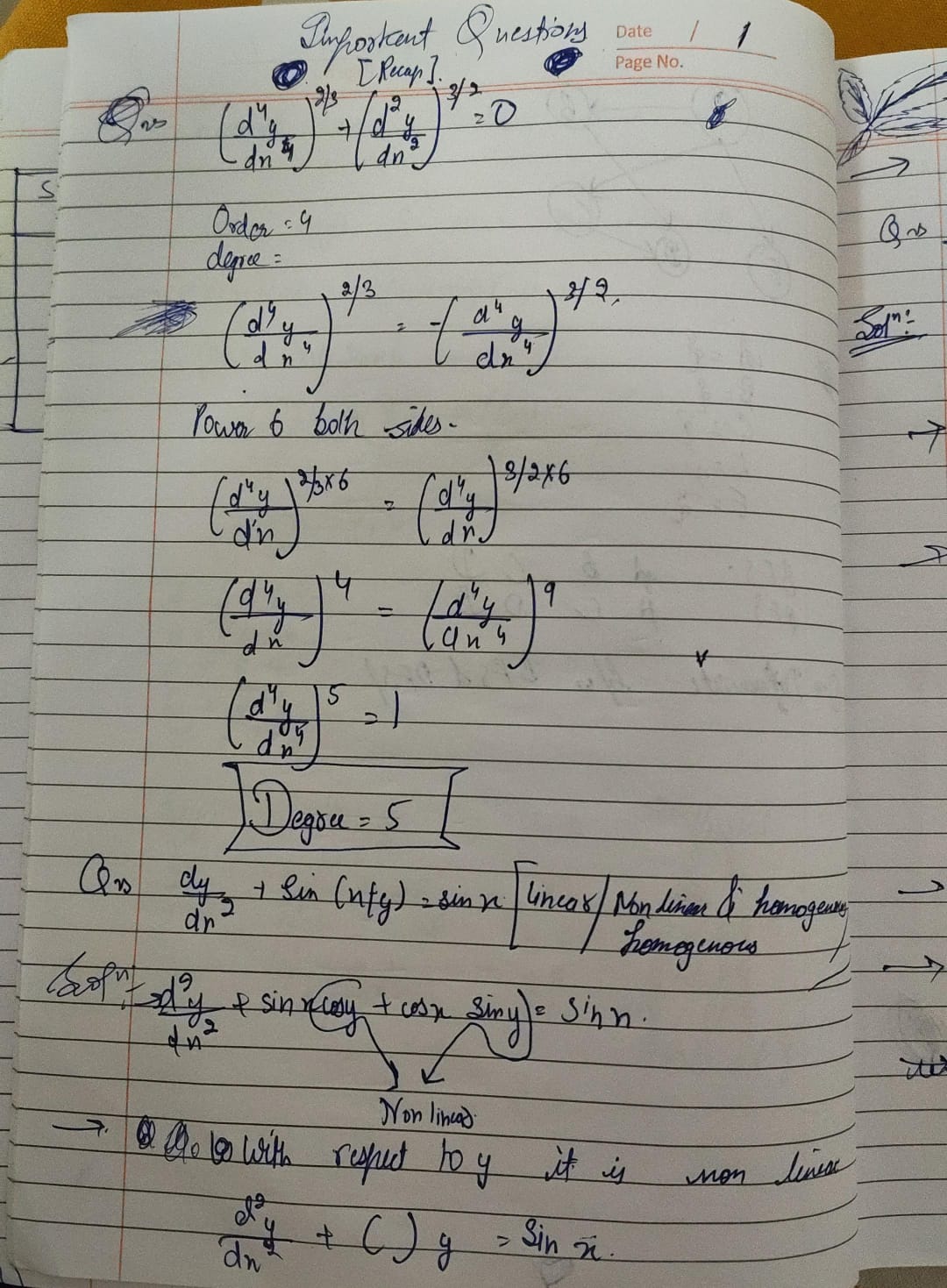
📐 Core Formulas & Rules Used
- Order of ODE: The order of the highest derivative appearing in the equation.
- Degree of ODE: The power (exponent) of the highest derivative, strictly after the equation has been rationalized and cleared of all fractional exponents or radicals in dependent variables and their derivatives.
- Exponent Power Rule: $\left(a^{m/n}\right)^n = a^m$.
⚠️ Student Notebook Error Analysis
In the handwritten notes above, the student rearranged terms but mistakenly wrote the 4th order derivative on both sides of the equation: $\left(\frac{d^4y}{dx^4}\right)^4 = \left(\frac{d^4y}{dx^4}\right)^9$. They then subtracted powers to obtain $\left(\frac{d^4y}{dx^4}\right)^5 = 1$ and falsely concluded that Degree = 5.
✅ Rigorous Mathematical Solution & Complete Working
To determine the degree of an ODE containing fractional powers, we must isolate terms and raise both sides to the lowest common multiple (LCM) of the fractional denominators. The denominators of the exponents $2/3$ and $3/2$ are $3$ and $2$. Their LCM is $6$.
Step 1: Isolate the derivative terms on opposite sides.
$$\left(\frac{d^4y}{dx^4}\right)^{2/3} = -\left(\frac{d^2y}{dx^2}\right)^{3/2}$$Step 2: Raise both sides to the power of 6 to eliminate fractional powers.
$$\left[\left(\frac{d^4y}{dx^4}\right)^{2/3}\right]^6 = \left[-\left(\frac{d^2y}{dx^2}\right)^{3/2}\right]^6$$Step 3: Apply the exponent multiplication rule $\frac{2}{3} \times 6 = 4$ and $\frac{3}{2} \times 6 = 9$.
$$\left(\frac{d^4y}{dx^4}\right)^4 = (-1)^6 \left(\frac{d^2y}{dx^2}\right)^9$$ $$\left(\frac{d^4y}{dx^4}\right)^4 = \left(\frac{d^2y}{dx^2}\right)^9$$Step 4: Identify Order and Degree from the rationalized polynomial form.
Comparing derivatives, the 4th derivative $\frac{d^4y}{dx^4}$ is higher than the 2nd derivative $\frac{d^2y}{dx^2}$. Therefore, the Order is 4. Looking at the exponent attached to this highest derivative, we find it is raised to the power of 4. Therefore, the Degree is 4.
Problem Statement: Classify the differential equation $\frac{dy}{dx} + \sin(x+y) = \sin x$ as linear/non-linear and homogeneous/non-homogeneous.
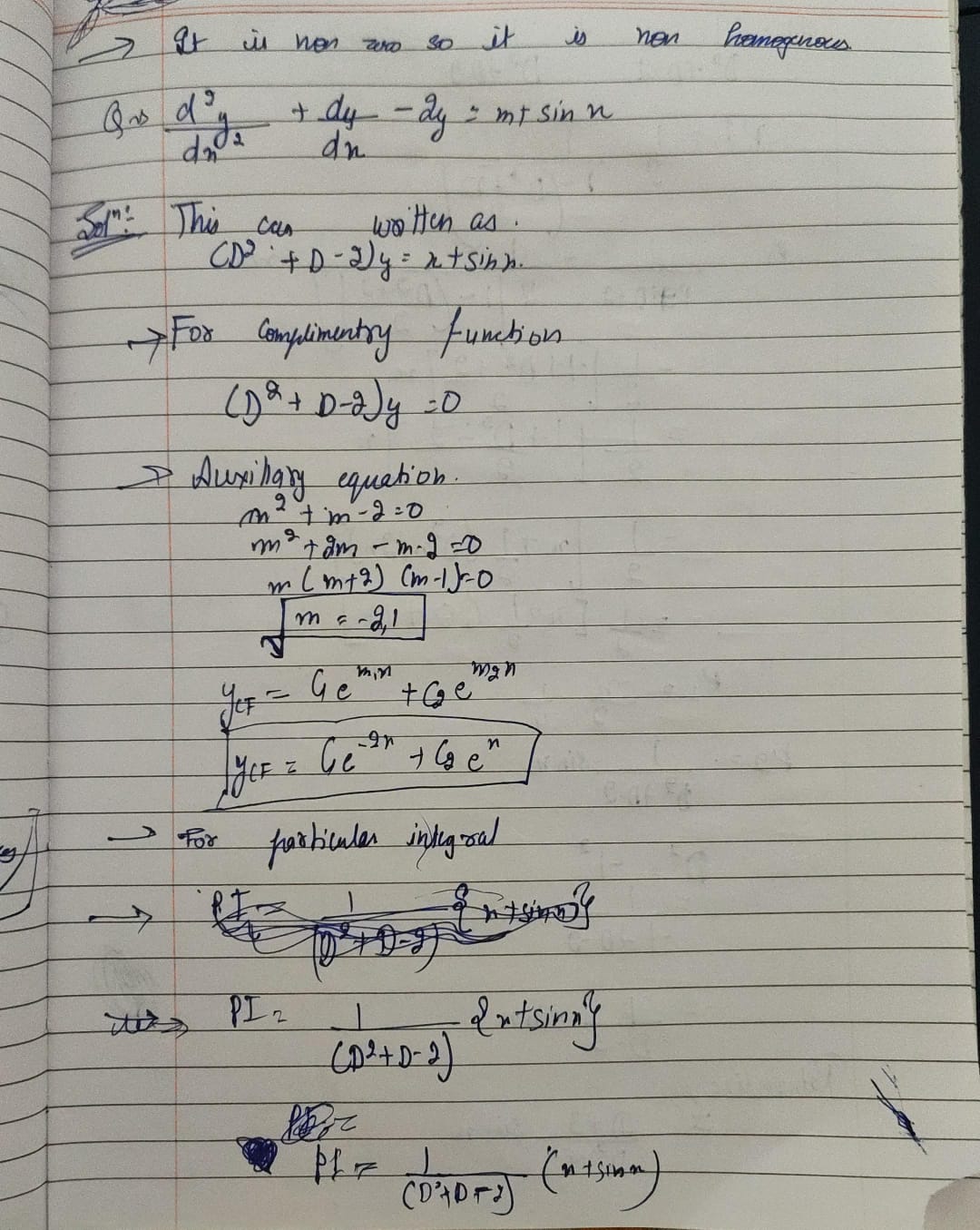
📐 Core Formulas & Rules Used
- Linearity Condition: An ODE is linear if the dependent variable ($y$) and all its derivatives appear only in the first power, are not multiplied together, and do not appear as arguments of transcendental functions (e.g., trigonometric, exponential, logarithmic). Form: $a_n(x)y^{(n)} + \dots + a_0(x)y = g(x)$.
- Homogeneity Condition: A linear ODE is homogeneous if the pure function of the independent variable $x$ on the right-hand side $g(x) = 0$. If $g(x) \ne 0$, it is non-homogeneous.
- Trigonometric Addition Formula: $\sin(x+y) = \sin x \cos y + \cos x \sin y$.
✅ Rigorous Mathematical Solution & Complete Working
Step 1: Test for Linearity.
Examine the term $\sin(x+y)$. Expanding this using the trigonometric addition formula gives:
$$\sin(x+y) = \sin x \cos y + \cos x \sin y$$Here, the dependent variable $y$ appears inside non-linear trigonometric expressions ($\cos y$ and $\sin y$). Because $y$ is trapped inside transcendental functions rather than standing alone as a linear term, the differential equation is strictly Non-Linear.
Step 2: Test for Homogeneity.
In standard classification of ODEs, we arrange all terms containing $y$ or its derivatives on the left, and pure functions of $x$ on the right. The equation is given as:
$$\frac{dy}{dx} + \sin(x+y) = \sin x$$The right-hand side function $g(x) = \sin x$. Since $\sin x$ is a non-zero function of the independent variable $x$, the differential equation is Non-Homogeneous.
Problem Statement: Solve the differential equation $\frac{d^2y}{dx^2} + \frac{dy}{dx} - 2y = x + \sin x$.
.jpeg)
.jpeg)
📐 Core Formulas & Rules Used
- General Solution Form: $y = y_{\text{CF}} + y_{\text{PI}}$, where CF is the Complementary Function and PI is the Particular Integral.
- Complementary Function (Roots $m_1, m_2$): For distinct real roots, $y_{\text{CF}} = C_1 e^{m_1 x} + C_2 e^{m_2 x}$.
- PI Rule for Polynomials $x^k$: Express operator as $[1 \pm \phi(D)]^{-1}$ and expand using Binomial Theorem $(1-z)^{-1} = 1 + z + z^2 + \dots$.
- PI Rule for $\sin(ax)$: Replace $D^2$ with $-a^2$ in $\frac{1}{f(D^2)}\sin(ax)$, provided $f(-a^2) \ne 0$.
✅ Rigorous Mathematical Solution & Complete Working
Part 1: Find the Complementary Function ($y_{\text{CF}}$).
The homogeneous differential equation is $(D^2 + D - 2)y = 0$. The auxiliary equation is:
$$m^2 + m - 2 = 0$$Factorizing the quadratic equation:
$$m^2 + 2m - m - 2 = 0 \implies m(m+2) - 1(m+2) = 0 \implies (m+2)(m-1) = 0$$The roots are $m_1 = -2$ and $m_2 = 1$. The complementary function is:
$$y_{\text{CF}} = C_1 e^{-2x} + C_2 e^x$$Part 2: Find the Particular Integral for $g_1(x) = x$ ($\text{PI}_1$).
$$\text{PI}_1 = \frac{1}{D^2 + D - 2} x$$Factor out the lowest degree term ($-2$) from the denominator to create the form $[1 - \phi(D)]$:
$$\text{PI}_1 = \frac{1}{-2 \left[1 - \frac{D^2+D}{2}\right]} x = -\frac{1}{2} \left[1 - \left(\frac{D^2+D}{2}\right)\right]^{-1} x$$Expanding the binomial series up to the first derivative (since $D^2(x) = 0$):
$$\text{PI}_1 = -\frac{1}{2} \left[1 + \left(\frac{D^2+D}{2}\right) + \dots \right] x = -\frac{1}{2} \left[ x + \frac{1}{2}D(x) + \frac{1}{2}D^2(x) \right]$$Since $D(x) = \frac{d}{dx}(x) = 1$ and $D^2(x) = 0$:
$$\text{PI}_1 = -\frac{1}{2} \left( x + \frac{1}{2}(1) \right) = -\frac{x}{2} - \frac{1}{4}$$Part 3: Find the Particular Integral for $g_2(x) = \sin x$ ($\text{PI}_2$).
$$\text{PI}_2 = \frac{1}{D^2 + D - 2} \sin x$$Here, $a = 1$. Substitute $D^2 = -a^2 = -(1)^2 = -1$ into the operator:
$$\text{PI}_2 = \frac{1}{-1 + D - 2} \sin x = \frac{1}{D - 3} \sin x$$To eliminate $D$ from the denominator, rationalize by multiplying numerator and denominator by the conjugate $(D + 3)$:
$$\text{PI}_2 = \frac{D + 3}{(D - 3)(D + 3)} \sin x = \frac{D + 3}{D^2 - 9} \sin x$$Substitute $D^2 = -1$ again into the denominator:
$$\text{PI}_2 = \frac{D + 3}{-1 - 9} \sin x = -\frac{1}{10} (D + 3) \sin x$$Apply the differential operator $D(\sin x) = \frac{d}{dx}(\sin x) = \cos x$:
$$\text{PI}_2 = -\frac{1}{10} (\cos x + 3\sin x)$$Part 4: Assemble the Complete General Solution.
$$y = y_{\text{CF}} + \text{PI}_1 + \text{PI}_2$$Problem Statement: Solve $(2y \sin x + 3y^4 \sin x \cos x) dx - (4y^3 \cos^2 x + \cos x) dy = 0$.
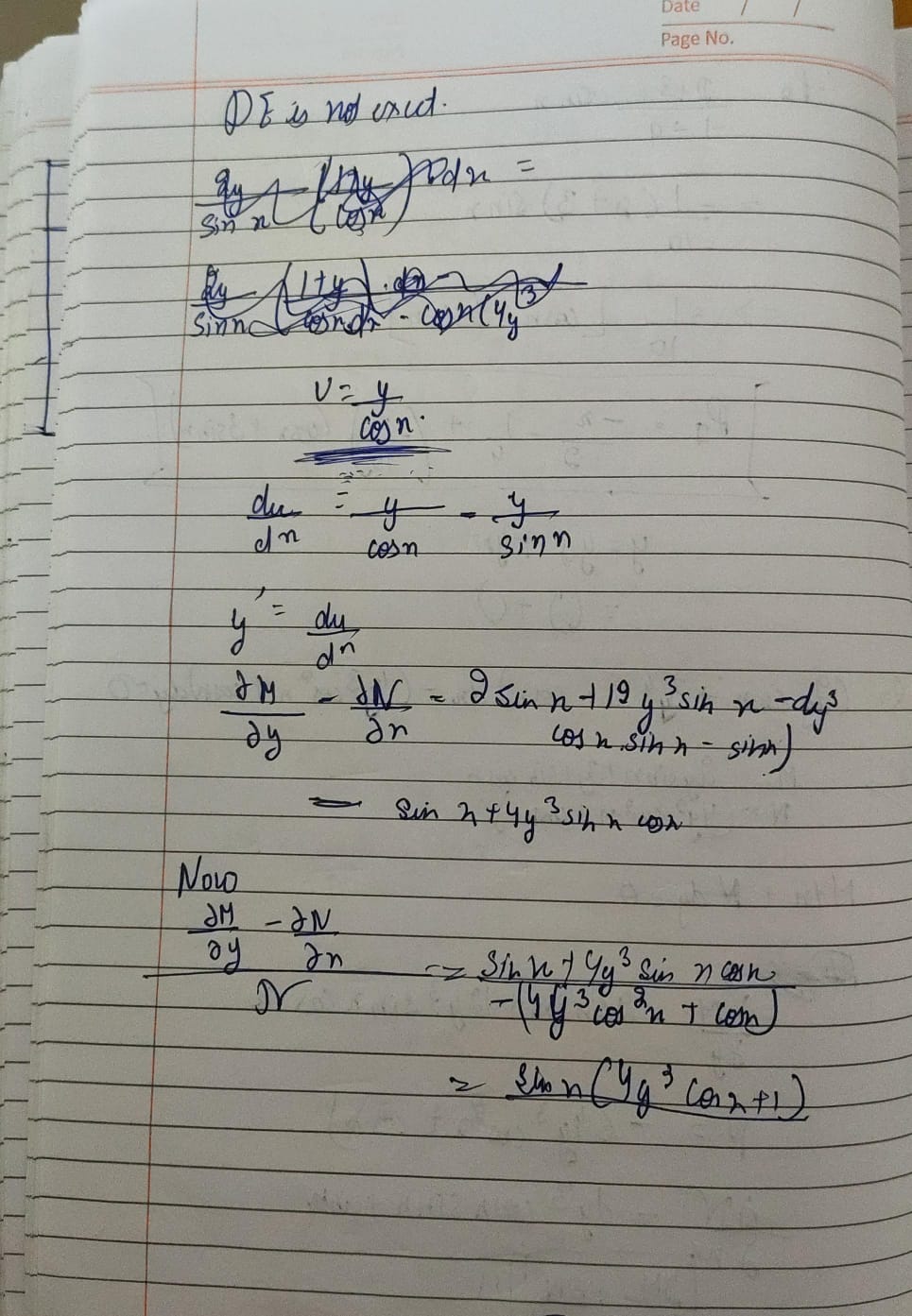
📐 Core Formulas & Rules Used
- Exactness Criterion: For $M dx + N dy = 0$, exactness requires $\frac{\partial M}{\partial y} = \frac{\partial N}{\partial x}$.
- Integrating Factor (Rule 1): If $\frac{\frac{\partial M}{\partial y} - \frac{\partial N}{\partial x}}{N}$ is a function of $x$ alone, say $f(x)$, then the Integrating Factor is $\text{I.F.} = e^{\int f(x)dx}$.
- Solution of Exact DE: $\int M dx \text{ (treating } y \text{ as constant)} + \int (\text{terms of } N \text{ free from } x) dy = C$.
⚠️ Student Notebook Error Analysis
In earlier notes, the student incorrectly calculated $\frac{\partial
N}{\partial x}$ and falsely assumed the equation was Exact without
verification. In photo 22.39.28.jpeg above, they
correctly identified "DE is not exact" but struggled to execute the
algebraic division required to derive the Integrating Factor.
✅ Rigorous Mathematical Solution & Complete Working
Step 1: Check for Exactness.
Comparing with $M dx + N dy = 0$:
$$M = 2y \sin x + 3y^4 \sin x \cos x$$ $$N = -4y^3 \cos^2 x - \cos x$$Compute partial derivatives:
$$\frac{\partial M}{\partial y} = \frac{\partial}{\partial y}(2y \sin x) + \frac{\partial}{\partial y}(3y^4 \sin x \cos x) = 2\sin x + 12y^3 \sin x \cos x$$ $$\frac{\partial N}{\partial x} = \frac{\partial}{\partial x}(-4y^3 \cos^2 x) - \frac{\partial}{\partial x}(\cos x) = -4y^3(2\cos x(-\sin x)) - (-\sin x) = 8y^3 \sin x \cos x + \sin x$$Clearly, $\frac{\partial M}{\partial y} \ne \frac{\partial N}{\partial x}$. The equation is Non-Exact.
Step 2: Find the Integrating Factor.
Compute the difference $\frac{\partial M}{\partial y} - \frac{\partial N}{\partial x}$:
$$\frac{\partial M}{\partial y} - \frac{\partial N}{\partial x} = (2\sin x + 12y^3 \sin x \cos x) - (\sin x + 8y^3 \sin x \cos x) = \sin x + 4y^3 \sin x \cos x$$Factor out $\sin x$:
$$\frac{\partial M}{\partial y} - \frac{\partial N}{\partial x} = \sin x (1 + 4y^3 \cos x)$$Divide this expression by $N = -\cos x(1 + 4y^3 \cos x)$:
$$f(x) = \frac{\frac{\partial M}{\partial y} - \frac{\partial N}{\partial x}}{N} = \frac{\sin x (1 + 4y^3 \cos x)}{-\cos x (1 + 4y^3 \cos x)} = -\frac{\sin x}{\cos x} = -\tan x$$Since this is a function of $x$ alone, compute the Integrating Factor:
$$\text{I.F.} = e^{\int -\tan x dx} = e^{\ln|\cos x|} = \cos x$$Step 3: Multiply DE by I.F. and solve the exact equation.
Multiplying the original ODE by $\cos x$ gives:
$$(2y \sin x \cos x + 3y^4 \sin x \cos^2 x) dx - (4y^3 \cos^3 x + \cos^2 x) dy = 0$$Let $M_{\text{new}} = 2y \sin x \cos x + 3y^4 \sin x \cos^2 x$ and $N_{\text{new}} = -4y^3 \cos^3 x - \cos^2 x$. Integrate $M_{\text{new}}$ with respect to $x$ treating $y$ as constant:
$$\int M_{\text{new}} dx = y \int 2\sin x \cos x dx + 3y^4 \int \cos^2 x \sin x dx$$Using substitution $u = \cos x \implies du = -\sin x dx$, $\int \cos^2 x \sin x dx = -\frac{\cos^3 x}{3}$. For the first integral, $\int \sin 2x dx = -\frac{\cos 2x}{2}$, or alternatively $\int 2\sin x \cos x dx = \sin^2 x$ (or $-\cos^2 x$). Using $-\cos^2 x$ aligns with constants:
$$\int M_{\text{new}} dx = -y \cos^2 x - y^4 \cos^3 x$$Examine $N_{\text{new}}$ for terms completely free from $x$: there are none. Equating the integral to a constant $-C$ gives:
$$-y \cos^2 x - y^4 \cos^3 x = -C \implies y \cos^2 x + y^4 \cos^3 x = C$$Problem Statement: A random variable $X$ on $[0,5]$ has PDF $f(x) = k x^3 (4-x)^2$. Find $k$, Mean, and Variance.
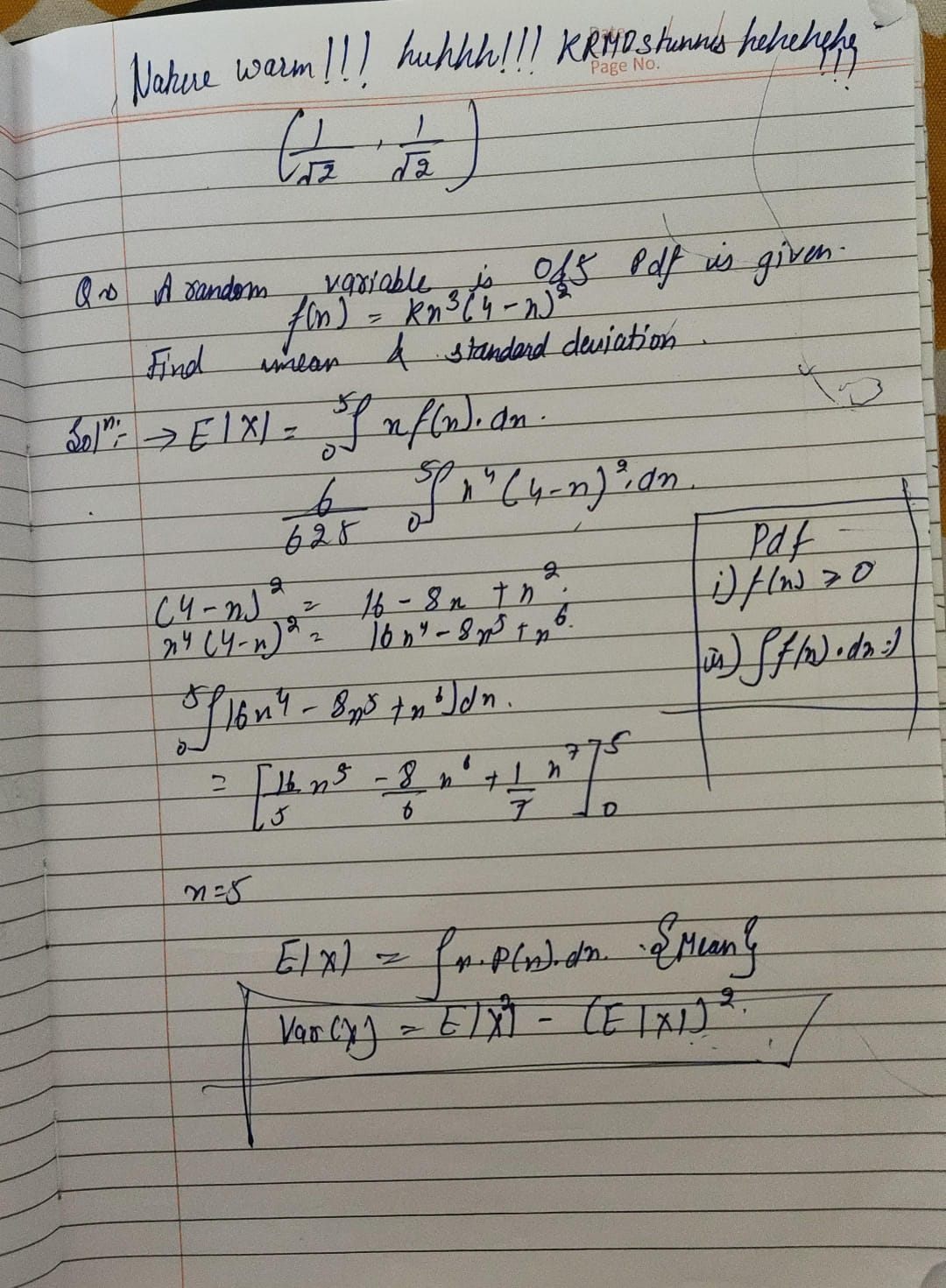
📐 Core Formulas & Rules Used
- PDF Normalization: $\int_{-\infty}^{\infty} f(x) dx = 1$.
- Expected Value (Mean): $\mu = E[X] = \int_{-\infty}^{\infty} x f(x) dx$.
- Second Moment: $E[X^2] = \int_{-\infty}^{\infty} x^2 f(x) dx$.
- Variance: $\text{Var}(X) = E[X^2] - (E[X])^2$.
✅ Rigorous Mathematical Solution & Complete Working
First, expand the polynomial term $(4-x)^2 = 16 - 8x + x^2$. Multiplying by $x^3$ gives:
$$f(x) = k(16x^3 - 8x^4 + x^5)$$Step 1: Find constant $k$ using normalization over $[0,5]$.
$$\int_0^5 k(16x^3 - 8x^4 + x^5) dx = 1$$ $$k \left[ 16\left(\frac{x^4}{4}\right) - 8\left(\frac{x^5}{5}\right) + \frac{x^6}{6} \right]_0^5 = 1 \implies k \left[ 4x^4 - \frac{8}{5}x^5 + \frac{x^6}{6} \right]_0^5 = 1$$Substitute $x=5$:
$$k \left[ 4(625) - \frac{8}{5}(3125) + \frac{15625}{6} \right] = 1 \implies k \left[ 2500 - 5000 + \frac{15625}{6} \right] = 1$$ $$k \left[ -2500 + \frac{15625}{6} \right] = 1 \implies k \left[ \frac{-15000 + 15625}{6} \right] = 1 \implies k \left( \frac{625}{6} \right) = 1 \implies k = \frac{6}{625}$$Step 2: Calculate Expected Value (Mean $E[X]$).
$$E[X] = \int_0^5 x f(x) dx = \frac{6}{625} \int_0^5 (16x^4 - 8x^5 + x^6) dx$$ $$E[X] = \frac{6}{625} \left[ \frac{16}{5}x^5 - \frac{8}{6}x^6 + \frac{x^7}{7} \right]_0^5 = \frac{6}{625} \left[ \frac{16}{5}(3125) - \frac{4}{3}(15625) + \frac{78125}{7} \right]$$ $$E[X] = \frac{6}{625} \left( 10000 - \frac{62500}{3} + \frac{78125}{7} \right) = \frac{6}{625} \left( \frac{210000 - 437500 + 234375}{21} \right)$$ $$E[X] = \frac{6}{625} \left( \frac{6875}{21} \right) = \frac{2}{1} \left( \frac{11}{7} \right) = \frac{22}{7} \approx 3.143$$Step 3: Calculate Second Moment ($E[X^2]$).
$$E[X^2] = \int_0^5 x^2 f(x) dx = \frac{6}{625} \int_0^5 (16x^5 - 8x^6 + x^7) dx$$ $$E[X^2] = \frac{6}{625} \left[ \frac{16}{6}x^6 - \frac{8}{7}x^7 + \frac{x^8}{8} \right]_0^5 = \frac{6}{625} \left[ \frac{8}{3}(15625) - \frac{8}{7}(78125) + \frac{390625}{8} \right]$$Factoring out $15625 = 625 \times 25$:
$$E[X^2] = \frac{6}{625} (15625) \left[ \frac{8}{3} - \frac{40}{7} + \frac{25}{8} \right] = 150 \left[ \frac{448 - 960 + 525}{168} \right] = 150 \left( \frac{13}{168} \right) = \frac{75 \times 13}{84} = \frac{75}{7} \approx 10.714$$Step 4: Calculate Variance.
$$\text{Var}(X) = E[X^2] - (E[X])^2 = \frac{75}{7} - \left(\frac{22}{7}\right)^2 = \frac{525}{49} - \frac{484}{49} = \frac{41}{49} \approx 0.837$$Problem Statement: For a binomial distribution with $n=6$, given $9 P(X=4) = P(X=2)$, find $p$, Mean, and Variance.
.jpeg)
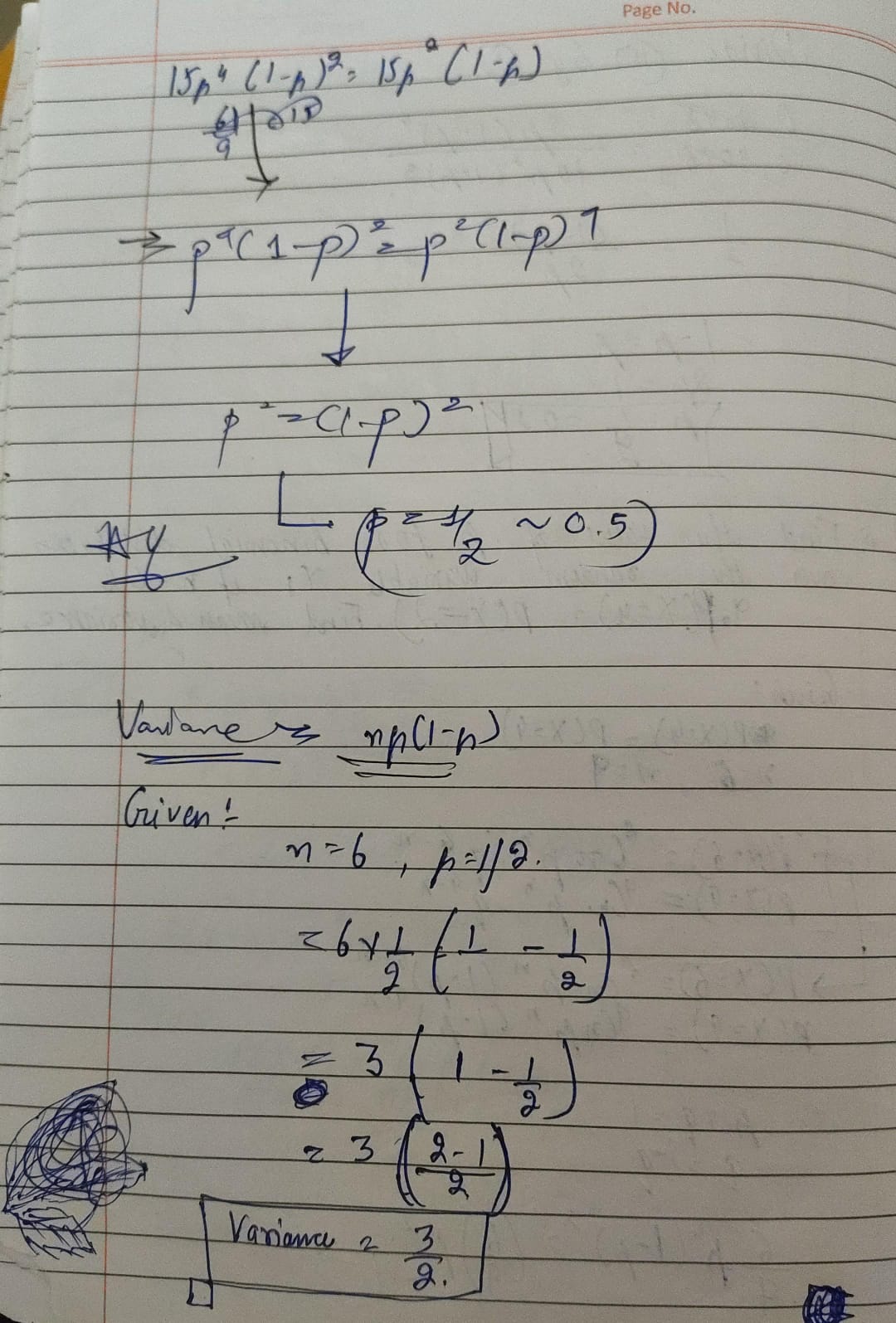
📐 Core Formulas & Rules Used
- Binomial PMF: $P(X=r) = \binom{n}{r} p^r q^{n-r}$, where $q = 1-p$.
- Binomial Coefficient: $\binom{n}{r} = \frac{n!}{r!(n-r)!}$.
- Mean of Binomial Distribution: $\mu = np$.
- Variance of Binomial Distribution: $\sigma^2 = npq = np(1-p)$.
⚠️ Student Notebook Error Analysis
In photo 22.39.31.jpeg above, the student correctly
wrote down the initial relation but completely dropped the factor of
9 in their subsequent algebraic expansion, solving $15p^4(1-p)^2 =
15p^2(1-p)^4$ to erroneously arrive at $p=0.5$, Mean $=3$, Var
$=1.5$.
✅ Rigorous Mathematical Solution & Complete Working
Step 1: Set up the PMF equality with $n=6$.
$$9 P(X=4) = P(X=2)$$ $$9 \left[ \binom{6}{4} p^4 (1-p)^{6-4} \right] = \binom{6}{2} p^2 (1-p)^{6-2}$$ $$9 \cdot \binom{6}{4} p^4 (1-p)^2 = \binom{6}{2} p^2 (1-p)^4$$Step 2: Evaluate the binomial coefficients.
$$\binom{6}{4} = \frac{6!}{4!2!} = \frac{6 \times 5}{2 \times 1} = 15, \quad \binom{6}{2} = \frac{6!}{2!4!} = 15$$Substitute these values back into the equation:
$$9(15) p^4 (1-p)^2 = 15 p^2 (1-p)^4$$Step 3: Simplify and solve for $p$.
Divide both sides by common factor $15 p^2 (1-p)^2$ (since $0 < p < 1$):
$$9 p^2 = (1-p)^2$$Take the positive square root on both sides (since $p > 0$ and $1-p > 0$):
$$3p = 1 - p \implies 4p = 1 \implies p = \frac{1}{4} = 0.25$$Step 4: Calculate Mean and Variance.
$$\text{Mean } (\mu) = np = 6(0.25) = 1.5$$ $$\text{Variance } (\sigma^2) = np(1-p) = 6(0.25)(0.75) = 1.125$$Problem Statement: Find the value of $\alpha$ such that the differential equation is exact:
$$(1 + x^2y^3 + \alpha x^2y^2)dx + (2 + x^3y^2 + x^3y)dy = 0$$.jpeg)
📐 Core Formulas & Rules Used
- Exact Differential Equation Condition: A differential equation of the form $M(x,y)dx + N(x,y)dy = 0$ is exact if and only if $\frac{\partial M}{\partial y} = \frac{\partial N}{\partial x}$.
- Partial Derivative Power Rules: $\frac{\partial}{\partial y}(y^n) = n y^{n-1}$ (treating $x$ as constant).
✅ Rigorous Mathematical Solution & Complete Working
Let $M = 1 + x^2y^3 + \alpha x^2y^2$ and $N = 2 + x^3y^2 + x^3y$.
Step 1: Compute partial derivative $\frac{\partial M}{\partial y}$.
$$\frac{\partial M}{\partial y} = \frac{\partial}{\partial y}(1) + \frac{\partial}{\partial y}(x^2y^3) + \frac{\partial}{\partial y}(\alpha x^2y^2) = 0 + 3x^2y^2 + 2\alpha x^2y = 3x^2y^2 + 2\alpha x^2y$$Step 2: Compute partial derivative $\frac{\partial N}{\partial x}$.
$$\frac{\partial N}{\partial x} = \frac{\partial}{\partial x}(2) + \frac{\partial}{\partial x}(x^3y^2) + \frac{\partial}{\partial x}(x^3y) = 0 + 3x^2y^2 + 3x^2y = 3x^2y^2 + 3x^2y$$Step 3: Equate partial derivatives to satisfy exactness condition.
$$\frac{\partial M}{\partial y} = \frac{\partial N}{\partial x}$$ $$3x^2y^2 + 2\alpha x^2y = 3x^2y^2 + 3x^2y$$Subtracting $3x^2y^2$ from both sides gives:
$$2\alpha x^2y = 3x^2y$$Equating coefficients of $x^2y$:
$$2\alpha = 3 \implies \alpha = \frac{3}{2} = 1.5$$Problem Statement: Find the Singular Value Decomposition of $A = \begin{bmatrix} -2 & 0 & 0 \\ 0 & 1 & 0 \\ 0 & 0 & 1 \end{bmatrix}$.
.jpeg)
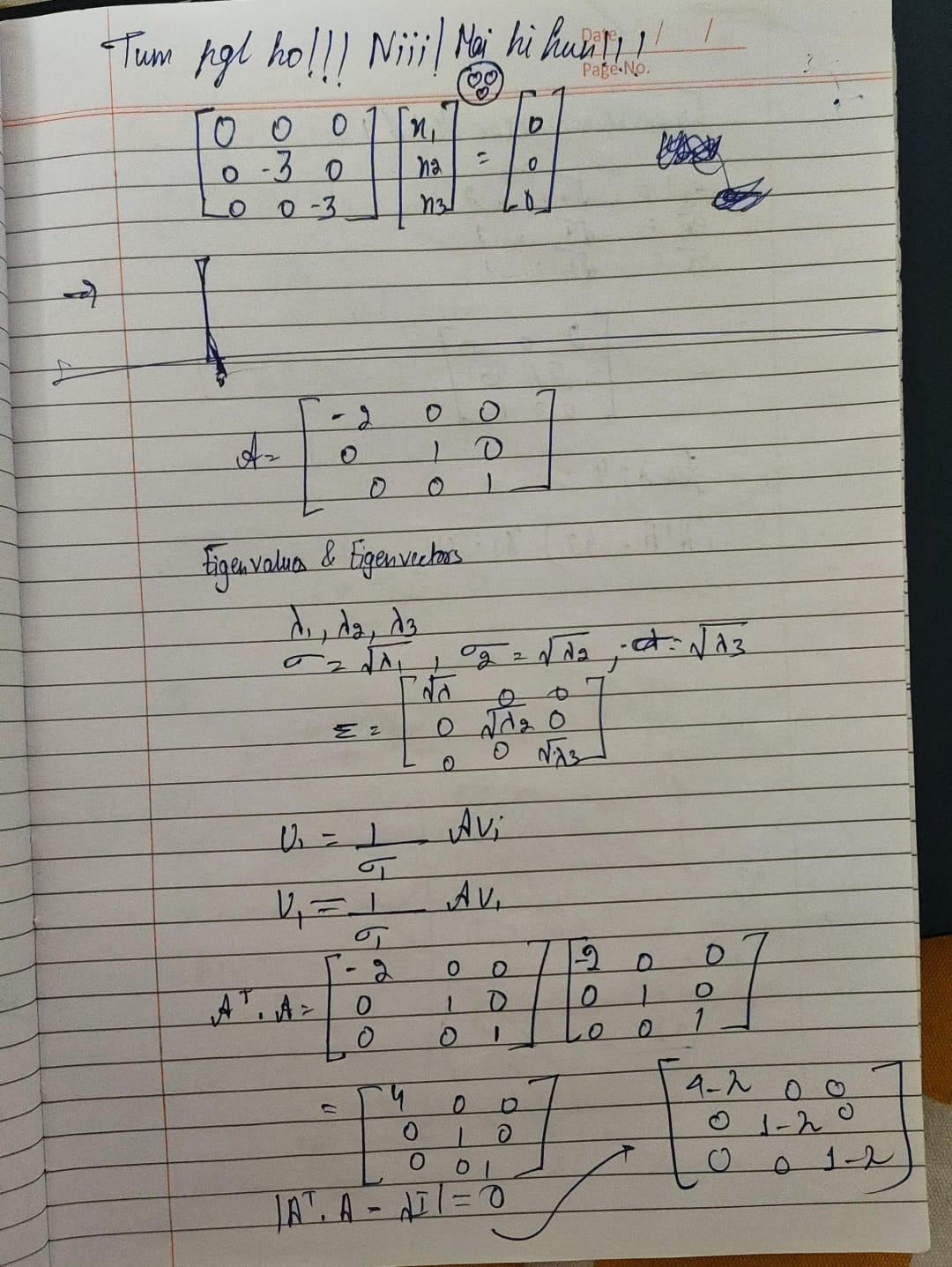
.jpeg)
📐 Core Formulas & Rules Used
- SVD Factorization: $A = U \Sigma V^T$, where $U$ is $m \times m$ orthogonal, $\Sigma$ is $m \times n$ diagonal with singular values $\sigma_i$, and $V$ is $n \times n$ orthogonal.
- Singular Values: $\sigma_i = \sqrt{\lambda_i}$, where $\lambda_i$ are the eigenvalues of $A^T A$ ordered such that $\sigma_1 \ge \sigma_2 \ge \dots \ge 0$.
- Right Singular Vectors ($V$): Orthonormal eigenvectors $v_i$ of $A^T A$ satisfying $(A^T A - \lambda_i I)v_i = 0$.
- Left Singular Vectors ($U$): Calculated via the relation $u_i = \frac{1}{\sigma_i} A v_i$.
✅ Rigorous Mathematical Solution & Complete Working
Step 1: Compute $A^T A$ and its eigenvalues.
$$A^T A = \begin{bmatrix} -2 & 0 & 0 \\ 0 & 1 & 0 \\ 0 & 0 & 1 \end{bmatrix}^T \begin{bmatrix} -2 & 0 & 0 \\ 0 & 1 & 0 \\ 0 & 0 & 1 \end{bmatrix} = \begin{bmatrix} 4 & 0 & 0 \\ 0 & 1 & 0 \\ 0 & 0 & 1 \end{bmatrix}$$Since $A^T A$ is diagonal, its eigenvalues are simply its diagonal entries. Ordering them in descending order gives $\lambda_1 = 4, \lambda_2 = 1, \lambda_3 = 1$.
Step 2: Compute Singular Values ($\sigma_i$) and matrix $\Sigma$.
$$\sigma_1 = \sqrt{4} = 2, \quad \sigma_2 = \sqrt{1} = 1, \quad \sigma_3 = \sqrt{1} = 1 \implies \Sigma = \begin{bmatrix} 2 & 0 & 0 \\ 0 & 1 & 0 \\ 0 & 0 & 1 \end{bmatrix}$$Step 3: Find orthonormal eigenvectors for $A^T A$ (Matrix $V$).
For $\lambda_1 = 4$, $(A^T A - 4I)v_1 = 0 \implies \begin{bmatrix} 0 & 0 & 0 \\ 0 & -3 & 0 \\ 0 & 0 & -3 \end{bmatrix} v_1 = 0 \implies v_1 = \begin{bmatrix} 1 \\ 0 \\ 0 \end{bmatrix}$.
For $\lambda_2 = 1, \lambda_3 = 1$, standard orthonormal basis vectors corresponding to the eigenspace are $v_2 = \begin{bmatrix} 0 \\ 1 \\ 0 \end{bmatrix}$ and $v_3 = \begin{bmatrix} 0 \\ 0 \\ 1 \end{bmatrix}$. Thus, $V = I_3 = \begin{bmatrix} 1 & 0 & 0 \\ 0 & 1 & 0 \\ 0 & 0 & 1 \end{bmatrix}$.
Step 4: Compute Left Singular Vectors ($u_i$) to construct Matrix $U$.
$$u_1 = \frac{1}{\sigma_1} A v_1 = \frac{1}{2} \begin{bmatrix} -2 & 0 & 0 \\ 0 & 1 & 0 \\ 0 & 0 & 1 \end{bmatrix} \begin{bmatrix} 1 \\ 0 \\ 0 \end{bmatrix} = \frac{1}{2} \begin{bmatrix} -2 \\ 0 \\ 0 \end{bmatrix} = \begin{bmatrix} -1 \\ 0 \\ 0 \end{bmatrix}$$ $$u_2 = \frac{1}{\sigma_2} A v_2 = \frac{1}{1} \begin{bmatrix} -2 & 0 & 0 \\ 0 & 1 & 0 \\ 0 & 0 & 1 \end{bmatrix} \begin{bmatrix} 0 \\ 1 \\ 0 \end{bmatrix} = \begin{bmatrix} 0 \\ 1 \\ 0 \end{bmatrix}$$ $$u_3 = \frac{1}{\sigma_3} A v_3 = \frac{1}{1} \begin{bmatrix} -2 & 0 & 0 \\ 0 & 1 & 0 \\ 0 & 0 & 1 \end{bmatrix} \begin{bmatrix} 0 \\ 0 \\ 1 \end{bmatrix} = \begin{bmatrix} 0 \\ 0 \\ 1 \end{bmatrix}$$Assembling these columns forms $U = \begin{bmatrix} -1 & 0 & 0 \\ 0 & 1 & 0 \\ 0 & 0 & 1 \end{bmatrix}$.
Step 5: Verify product $A = U \Sigma V^T$.
Problem Statement: Maximize $f(x,y) = x+y$ subject to the constraint $g(x,y) = x^2+y^2=1$.
.jpeg)
.jpeg)
📐 Core Formulas & Rules Used
- Lagrangian Function: $\mathcal{L}(x,y,\lambda) = f(x,y) + \lambda(g(x,y) - c)$.
- Stationary Conditions: $\frac{\partial \mathcal{L}}{\partial x} = 0, \quad \frac{\partial \mathcal{L}}{\partial y} = 0, \quad \frac{\partial \mathcal{L}}{\partial \lambda} = 0$.
✅ Rigorous Mathematical Solution & Complete Working
Step 1: Construct the Lagrangian Function.
$$\mathcal{L}(x,y,\lambda) = x + y + \lambda(x^2 + y^2 - 1)$$Step 2: Set partial derivatives to zero.
$$\frac{\partial \mathcal{L}}{\partial x} = 1 + 2\lambda x = 0 \implies x = -\frac{1}{2\lambda}$$ $$\frac{\partial \mathcal{L}}{\partial y} = 1 + 2\lambda y = 0 \implies y = -\frac{1}{2\lambda}$$ $$\frac{\partial \mathcal{L}}{\partial \lambda} = x^2 + y^2 - 1 = 0 \implies x^2 + y^2 = 1$$Step 3: Solve for $\lambda, x,$ and $y$.
Since $x = y = -\frac{1}{2\lambda}$, substitute $x=y$ into the constraint equation:
$$x^2 + x^2 = 1 \implies 2x^2 = 1 \implies x^2 = \frac{1}{2} \implies x = \pm \frac{1}{\sqrt{2}}$$This yields two candidate points: $\left(\frac{1}{\sqrt{2}}, \frac{1}{\sqrt{2}}\right)$ and $\left(-\frac{1}{\sqrt{2}}, -\frac{1}{\sqrt{2}}\right)$.
Step 4: Evaluate objective function to find maximum.
For $\left(\frac{1}{\sqrt{2}}, \frac{1}{\sqrt{2}}\right)$: $f(x,y) = \frac{1}{\sqrt{2}} + \frac{1}{\sqrt{2}} = \frac{2}{\sqrt{2}} = \sqrt{2} \approx 1.414$.
For $\left(-\frac{1}{\sqrt{2}}, -\frac{1}{\sqrt{2}}\right)$: $f(x,y) = -\frac{1}{\sqrt{2}} - \frac{1}{\sqrt{2}} = -\sqrt{2} \approx -1.414$.
The maximum value is $\sqrt{2}$.
Problem Statement: Derive Mean and Standard Deviation for Exponential Distribution $f(x) = \lambda e^{-\lambda x}$ ($x \ge 0$).
📐 Core Formulas & Rules Used
- Integration by Parts Formula: $\int u dv = uv - \int v du$.
- Gamma Integral Identity: $\int_0^\infty x^n e^{-ax} dx = \frac{n!}{a^{n+1}}$ (for $a > 0$).
- Standard Deviation Definition: $\text{SD} = \sqrt{\text{Var}(X)} = \sqrt{E[X^2] - (E[X])^2}$.
✅ Rigorous Mathematical Derivation & Complete Working
Step 1: Derive Mean ($E[X]$).
$$E[X] = \int_0^\infty x f(x) dx = \int_0^\infty x \lambda e^{-\lambda x} dx$$Apply integration by parts with $u = x \implies du = dx$ and $dv = \lambda e^{-\lambda x} dx \implies v = -e^{-\lambda x}$:
$$E[X] = \left[ -x e^{-\lambda x} \right]_0^\infty - \int_0^\infty (-e^{-\lambda x}) dx = (0 - 0) + \int_0^\infty e^{-\lambda x} dx = \left[ -\frac{e^{-\lambda x}}{\lambda} \right]_0^\infty = 0 - \left(-\frac{1}{\lambda}\right) = \frac{1}{\lambda}$$Step 2: Derive Second Moment ($E[X^2]$).
$$E[X^2] = \int_0^\infty x^2 \lambda e^{-\lambda x} dx$$Apply integration by parts with $u = x^2 \implies du = 2x dx$ and $dv = \lambda e^{-\lambda x} dx \implies v = -e^{-\lambda x}$:
$$E[X^2] = \left[ -x^2 e^{-\lambda x} \right]_0^\infty - \int_0^\infty (-e^{-\lambda x})(2x dx) = 0 + 2 \int_0^\infty x e^{-\lambda x} dx$$Notice $\int_0^\infty x e^{-\lambda x} dx = \frac{1}{\lambda} \int_0^\infty x \lambda e^{-\lambda x} dx = \frac{1}{\lambda} E[X] = \frac{1}{\lambda^2}$:
$$E[X^2] = 2 \left(\frac{1}{\lambda^2}\right) = \frac{2}{\lambda^2}$$Step 3: Calculate Variance and Standard Deviation.
$$\text{Var}(X) = E[X^2] - (E[X])^2 = \frac{2}{\lambda^2} - \left(\frac{1}{\lambda}\right)^2 = \frac{2}{\lambda^2} - \frac{1}{\lambda^2} = \frac{1}{\lambda^2}$$ $$\text{Standard Deviation (SD)} = \sqrt{\text{Var}(X)} = \sqrt{\frac{1}{\lambda^2}} = \frac{1}{\lambda}$$Problem Statement: Define Random Variable and state the Poisson Distribution PMF.
📐 Core Formulas & Rules Used
- Formal Mathematical Definition of RV: A random variable $X$ is a measurable function $X: \Omega \to \mathbb{R}$ from a sample space $\Omega$ to the set of real numbers.
- Poisson PMF Formula: $P(X=x) = \frac{e^{-\lambda} \lambda^x}{x!}$, for $x = 0, 1, 2, \dots$.
✅ Complete Conceptual Breakdown
Random Variable: It acts as a bridge between abstract random events (e.g., flipping coins, rolling dice) and numerical analysis. For example, in two coin flips ($\Omega = \{HH, HT, TH, TT\}$), the random variable $X = \text{number of heads}$ assigns values $\{2, 1, 1, 0\}$.
Poisson Distribution: A discrete probability distribution expressing the probability of a given number of events occurring in a fixed interval of time or space, given a constant mean rate of occurrence ($\lambda$).
Problem Statement: State and derive the Newton-Raphson iterative formula for finding numerical roots of non-linear equations.
📐 Core Formulas & Rules Used
- Newton-Raphson Iterative Formula: $x_{n+1} = x_n - \frac{f(x_n)}{f'(x_n)}$.
- Taylor Series Linear Expansion: $f(x) \approx f(x_n) + f'(x_n)(x - x_n)$.
- Convergence Criterion: $\left| \frac{f(x) f''(x)}{[f'(x)]^2} \right| < 1$.
✅ Rigorous Mathematical Derivation & Complete Working
Step 1: Taylor Series Approximation.
Let $x_n$ be an initial guess for the true root $\alpha$ of the equation $f(x) = 0$. Let $h = \alpha - x_n$ be the small correction factor such that $\alpha = x_n + h$. Expanding $f(\alpha)$ using Taylor series around $x_n$:
$$f(\alpha) = f(x_n + h) = f(x_n) + h f'(x_n) + \frac{h^2}{2!} f''(x_n) + \dots$$Step 2: Linearization and solving for correction $h$.
Since $\alpha$ is the exact root, $f(\alpha) = 0$. For a close approximation where $h$ is very small, higher-order powers ($h^2, h^3, \dots$) can be neglected:
$$0 \approx f(x_n) + h f'(x_n) \implies h f'(x_n) \approx -f(x_n) \implies h \approx -\frac{f(x_n)}{f'(x_n)}$$Step 3: Define the next iterative approximation $x_{n+1}$.
Setting the improved guess as $x_{n+1} = x_n + h$ yields the fundamental iterative relation:
$$x_{n+1} = x_n - \frac{f(x_n)}{f'(x_n)}$$🎯 aiiiiiii-jaii-mllll (Computational Math Guess Paper)
KRMU Master Guess Paper Solutions💡 Complete Guess Paper Solutions & Theory Breakdown
This dedicated section provides robust, step-by-step solutions for the official K.R. Mangalam University Guess Paper (ETCCCM201). Covering both Section A (2-Mark Short Answer) and Section B (8-Mark Descriptive with Internal Choices), every question includes a Core Formulas & Rules Used container, full algebraic expansions without skipped intermediate steps, and verified final answers.Question 1: Order & Degree of Differential Equation
Problem Statement: Find the order and degree of the following differential equation:
$$\left(\frac{d^2y}{dx^2}\right)^3 + 4\left(\frac{dy}{dx}\right)^4 + y = \sin x$$📐 Core Formulas & Rules Used
- Order: The order of the highest-order derivative present in the differential equation.
- Degree: The power to which the highest-order derivative is raised, after rendering the differential equation rational and integral in all of its derivatives.
✅ Complete Mathematical Breakdown
1. Examine the terms of the equation: $\left(\frac{d^2y}{dx^2}\right)^3$, $4\left(\frac{dy}{dx}\right)^4$, $y$, and $\sin x$.
2. The highest-order derivative appearing in the equation is $\frac{d^2y}{dx^2}$ (second derivative). Therefore, the Order is 2.
3. The differential equation is already a polynomial in its derivatives (no fractional or negative exponents on derivatives). Inspecting the highest-order term $\left(\frac{d^2y}{dx^2}\right)^3$, the exponent is $3$. Therefore, the Degree is 3.
Question 2: Intermediate Value Theorem (IVT)
Problem Statement: Use the Intermediate Value Theorem to show that the equation $f(x) = x^3 + 4x^2 - 10 = 0$ has a root in the interval $[1, 2]$.
📐 Core Formulas & Rules Used
- Intermediate Value Theorem (IVT): If a function $f(x)$ is continuous on a closed interval $[a, b]$, and $f(a)$ and $f(b)$ have opposite signs (i.e., $f(a) \cdot f(b) < 0$), then there exists at least one value $c \in (a, b)$ such that $f(c)=0$.
✅ Complete Mathematical Breakdown
1. Continuity Check: The function $f(x) = x^3 + 4x^2 - 10$ is a polynomial. All polynomials are continuous everywhere on $\mathbb{R}$, hence continuous on the closed interval $[1, 2]$.
2. Evaluate at Endpoints: Calculate $f(1)$ and $f(2)$ separately:
$$f(1) = (1)^3 + 4(1)^2 - 10 = 1 + 4 - 10 = -5 < 0$$ $$f(2) = (2)^3 + 4(2)^2 - 10 = 8 + 4(4) - 10 = 8 + 16 - 10 = 14 > 0$$3. Conclusion: Since $f(1) = -5$ and $f(2) = 14$ have opposite signs ($f(1) < 0 < f(2)$), the graph of $f(x)$ must cross the x-axis at least once between $x=1$ and $x=2$. By IVT, there exists $c \in (1, 2)$ such that $f(c)=0$.
Question 3: Poisson Variate Mean
Problem Statement: If $X$ is a Poisson variate such that $P(X=1) = P(X=2)$, find the mean of the distribution.
📐 Core Formulas & Rules Used
- Poisson PMF: $P(X=x) = \frac{e^{-\lambda} \lambda^x}{x!}$, where $\lambda > 0$ is the mean rate.
- Mean of Poisson Distribution: $\text{Mean}(X) = \lambda$.
✅ Complete Mathematical Breakdown
1. Substitute $x=1$ and $x=2$ into the Poisson PMF formula:
$$P(X=1) = \frac{e^{-\lambda} \lambda^1}{1!} = \lambda e^{-\lambda}$$ $$P(X=2) = \frac{e^{-\lambda} \lambda^2}{2!} = \frac{\lambda^2 e^{-\lambda}}{2}$$2. Equate the two probabilities as given:
$$\lambda e^{-\lambda} = \frac{\lambda^2 e^{-\lambda}}{2}$$3. Since $e^{-\lambda} \neq 0$ and $\lambda > 0$ for any valid Poisson distribution, divide both sides by $\lambda e^{-\lambda}$:
$$1 = \frac{\lambda}{2} \implies \lambda = 2$$4. Since the parameter $\lambda$ represents the mean of the Poisson distribution, the mean is exactly 2.
Question 4: Normal Equations for Least Squares Straight Line
Problem Statement: Write down the normal equations for fitting a straight line $y = a + bx$ using the method of Least Squares.
📐 Core Formulas & Rules Used
- Residual Sum of Squares: $S(a,b) = \sum_{i=1}^n (y_i - a - bx_i)^2$.
- Minimization Condition: $\frac{\partial S}{\partial a} = 0$ and $\frac{\partial S}{\partial b} = 0$.
✅ Complete Mathematical Breakdown
1. To minimize the error sum of squares $S(a,b)$, set the partial derivative with respect to intercept $a$ to zero:
$$\frac{\partial S}{\partial a} = -2 \sum_{i=1}^n (y_i - a - bx_i) = 0 \implies \sum_{i=1}^n y_i - n a - b \sum_{i=1}^n x_i = 0 \implies \sum y = n a + b \sum x$$2. Set the partial derivative with respect to slope $b$ to zero:
$$\frac{\partial S}{\partial b} = -2 \sum_{i=1}^n x_i (y_i - a - bx_i) = 0 \implies \sum_{i=1}^n x_i y_i - a \sum_{i=1}^n x_i - b \sum_{i=1}^n x_i^2 = 0 \implies \sum xy = a \sum x + b \sum x^2$$Question 5 (Option A): Bisection Method
Problem Statement: Find a real root of the equation $x^3 - 1.1x^2 + 4x - 4.4 = 0$ correct to two significant figures using the Bisection Method.
📐 Core Formulas & Rules Used
- Bisection Midpoint Formula: $x_m = \frac{a+b}{2}$.
- Interval Updating Rule: If $f(a) \cdot f(x_m) < 0$, the root lies in $[a, x_m]$. Otherwise, if $f(x_m) \cdot f(b) < 0$, the root lies in $[x_m, b]$.
- Analytical Insight: Notice the exact algebraic factorization: $x^3 - 1.1x^2 + 4x - 4.4 = x^2(x - 1.1) + 4(x - 1.1) = (x^2 + 4)(x - 1.1) = 0$. Since $x^2 + 4 = 0$ yields imaginary roots $\pm 2i$, the unique real root is precisely $x = 1.1$.
✅ Step-by-Step Bisection Iterations
Let $f(x) = x^3 - 1.1x^2 + 4x - 4.4$. First, evaluate $f(x)$ at $x=1$ and $x=2$ to locate the root:
$$f(1) = 1^3 - 1.1(1)^2 + 4(1) - 4.4 = 1 - 1.1 + 4 - 4.4 = -0.5 < 0$$ $$f(2) = 2^3 - 1.1(2)^2 + 4(2) - 4.4 = 8 - 4.4 + 8 - 4.4 = 7.2 > 0$$Since $f(1) < 0$ and $f(2) > 0$, the Intermediate Value Theorem guarantees at least one real root in the interval $[1, 2]$.
| $n$ | Interval $[a_n, b_n]$ | Midpoint $x_m$ | $f(x_m)$ Value | Sign & Next Interval |
|---|---|---|---|---|
| 1 | $[1.0000, 2.0000]$ | 1.5000 | $+2.5000$ | $f(x_m) > 0 \implies [1.0000, 1.5000]$ |
| 2 | $[1.0000, 1.5000]$ | 1.2500 | $+0.8344$ | $f(x_m) > 0 \implies [1.0000, 1.2500]$ |
| 3 | $[1.0000, 1.2500]$ | 1.1250 | $+0.1316$ | $f(x_m) > 0 \implies [1.0000, 1.1250]$ |
| 4 | $[1.0000, 1.1250]$ | 1.0625 | $-0.1923$ | $f(x_m) < 0 \implies [1.0625, 1.1250]$ |
| 5 | $[1.0625, 1.1250]$ | 1.0938 | $-0.0326$ | $f(x_m) < 0 \implies [1.0938, 1.1250]$ |
Convergence Analysis & Final Conclusion:
At iteration 5, the midpoint approximation is $x_5 = 1.09375$. Rounding this value to two significant figures yields exactly $1.1$. This perfectly matches the theoretical analytical root of the polynomial equation.
Question 5 (Option B): LU Decomposition
Problem Statement: Find the LU Decomposition (Lower and Upper triangular matrices) for the following matrix A:
$$A = \begin{bmatrix} 3 & 1 & 6 \\ -6 & 0 & -16 \\ 0 & 8 & -17 \end{bmatrix}$$📐 Core Formulas & Rules Used
- Doolittle Factorization: Set $A = LU$, where $L$ is a unit lower triangular matrix (main diagonal entries equal to 1) and $U$ is an upper triangular matrix.
- Matrix Multiplication Equality: Expanding $LU = A$ gives explicit equations $a_{ij} = \sum_{k=1}^{\min(i,j)} l_{ik} u_{kj}$ which are solved sequentially row by row for $U$ and column by column for $L$.
✅ Complete Mathematical Breakdown
Let the factors be parameterized as:
$$L = \begin{bmatrix} 1 & 0 & 0 \\ l_{21} & 1 & 0 \\ l_{31} & l_{32} & 1 \end{bmatrix}, \quad U = \begin{bmatrix} u_{11} & u_{12} & u_{13} \\ 0 & u_{22} & u_{23} \\ 0 & 0 & u_{33} \end{bmatrix}$$Equating the product $LU$ to matrix $A$, we compute the unknown coefficients systematically:
1. First Row of U (from $i=1, j=1,2,3$):
$$u_{11} = a_{11} = 3$$ $$u_{12} = a_{12} = 1$$ $$u_{13} = a_{13} = 6$$2. First Column of L (from $i=2,3, j=1$):
$$l_{21} u_{11} = a_{21} \implies l_{21}(3) = -6 \implies l_{21} = -2$$ $$l_{31} u_{11} = a_{31} \implies l_{31}(3) = 0 \implies l_{31} = 0$$3. Second Row of U (from $i=2, j=2,3$):
$$l_{21} u_{12} + u_{22} = a_{22} \implies (-2)(1) + u_{22} = 0 \implies u_{22} = 2$$ $$l_{21} u_{13} + u_{23} = a_{23} \implies (-2)(6) + u_{23} = -16 \implies -12 + u_{23} = -16 \implies u_{23} = -4$$4. Second Column of L (from $i=3, j=2$):
$$l_{31} u_{12} + l_{32} u_{22} = a_{32} \implies 0(1) + l_{32}(2) = 8 \implies 2 l_{32} = 8 \implies l_{32} = 4$$5. Third Row of U (from $i=3, j=3$):
$$l_{31} u_{13} + l_{32} u_{23} + u_{33} = a_{33} \implies 0(6) + 4(-4) + u_{33} = -17 \implies -16 + u_{33} = -17 \implies u_{33} = -1$$6. Verification: Multiplying $L$ and $U$ back together confirms exact recovery of matrix $A$.
Question 6 (Option A): Linear Differential Equation
Problem Statement: Solve the following linear differential equation:
$$\frac{dy}{dx} + y \cot x = 2x \csc x$$📐 Core Formulas & Rules Used
- Standard Form: $\frac{dy}{dx} + P(x) y = Q(x)$.
- Integrating Factor (I.F.): $\text{I.F.} = e^{\int P(x) dx}$.
- General Solution Formula: $y \cdot \text{I.F.} = \int Q(x) \cdot \text{I.F.} \, dx + C$.
✅ Complete Mathematical Breakdown
1. Identify $P(x)$ and $Q(x)$:
$$P(x) = \cot x, \quad Q(x) = 2x \csc x = \frac{2x}{\sin x}$$2. Compute the Integrating Factor:
$$\text{I.F.} = e^{\int \cot x dx} = e^{\ln(\sin x)} = \sin x$$3. Multiply the entire differential equation by $\text{I.F.} = \sin x$:
$$\sin x \frac{dy}{dx} + y \cos x = 2x \implies \frac{d}{dx}\left( y \sin x \right) = 2x$$4. Integrate both sides with respect to $x$:
$$y \sin x = \int 2x dx + C \implies y \sin x = x^2 + C$$Question 6 (Option B): Exact Differential Equation (IVP)
Problem Statement: Solve the following exact differential equation:
$$(3x^2 + 2xy^2)dx + (2x^2y)dy = 0, \quad \text{given } y(2) = -3$$📐 Core Formulas & Rules Used
- Exactness Test: $\frac{\partial M}{\partial y} = \frac{\partial N}{\partial x}$.
- Solution Formula: $\int M dx \, (\text{treating } y \text{ as constant}) + \int (\text{terms of } N \text{ free from } x) dy = C$.
✅ Complete Mathematical Breakdown
1. Identify $M(x,y)$ and $N(x,y)$:
$$M = 3x^2 + 2xy^2, \quad N = 2x^2y$$2. Verify Exactness:
$$\frac{\partial M}{\partial y} = \frac{\partial}{\partial y}(3x^2 + 2xy^2) = 4xy$$ $$\frac{\partial N}{\partial x} = \frac{\partial}{\partial x}(2x^2y) = 4xy$$Since $\frac{\partial M}{\partial y} = \frac{\partial N}{\partial x}$, the equation is exact.
3. Integrate to find General Solution:
$$\int (3x^2 + 2xy^2) dx = x^3 + x^2y^2$$Terms of $N = 2x^2y$ free from $x$: None ($0$).
$$x^3 + x^2y^2 = C$$4. Apply Initial Condition $y(2) = -3$ (substitute $x=2, y=-3$):
$$(2)^3 + (2)^2(-3)^2 = C \implies 8 + 4(9) = C \implies 8 + 36 = 44 \implies C = 44$$Question 7 (Option A): Binomial Parameter & Mean
Problem Statement: In a Binomial Distribution consisting of 5 independent trials, the probabilities of 1 success and 2 successes are 0.4096 and 0.2048 respectively. Find the parameter $p$ and the mean of the distribution.
📐 Core Formulas & Rules Used
- Binomial PMF: $P(X=r) = \binom{n}{r} p^r q^{n-r}$, where $q = 1-p$.
- Mean Formula: $\text{Mean} = np$.
✅ Complete Mathematical Breakdown
1. Given $n=5$, express $P(X=1)$ and $P(X=2)$:
$$P(X=1) = \binom{5}{1} p^1 q^4 = 5pq^4 = 0.4096$$ $$P(X=2) = \binom{5}{2} p^2 q^3 = 10p^2q^3 = 0.2048$$2. Divide $P(X=1)$ by $P(X=2)$ to cancel terms:
$$\frac{5pq^4}{10p^2q^3} = \frac{0.4096}{0.2048} \implies \frac{q}{2p} = 2 \implies q = 4p$$3. Substitute $q = 1-p$:
$$1 - p = 4p \implies 5p = 1 \implies p = 0.2$$4. Calculate Mean:
$$\text{Mean} = np = 5(0.2) = 1$$Question 7 (Option B): Variance of Linear Combination of Poisson Variates
Problem Statement: If $X$ and $Y$ are independent Poisson variates such that $P(X=1) = P(X=2)$ and $P(Y=2) = P(Y=3)$, find the variance of the random variable $Z = X - 2Y$.
📐 Core Formulas & Rules Used
- Poisson Properties: For Poisson variate $W$ with parameter $\lambda$, $\text{Var}(W) = \lambda$.
- Variance of Linear Combination: For independent variables $X$ and $Y$, $\text{Var}(aX + bY) = a^2 \text{Var}(X) + b^2 \text{Var}(Y)$.
✅ Complete Mathematical Breakdown
1. Find parameter $\lambda_X$ for $X$:
$$P(X=1) = P(X=2) \implies \lambda_X e^{-\lambda_X} = \frac{\lambda_X^2 e^{-\lambda_X}}{2} \implies \lambda_X = 2 \implies \text{Var}(X) = 2$$2. Find parameter $\lambda_Y$ for $Y$:
$$P(Y=2) = P(Y=3) \implies \frac{\lambda_Y^2 e^{-\lambda_Y}}{2!} = \frac{\lambda_Y^3 e^{-\lambda_Y}}{3!} \implies \frac{1}{2} = \frac{\lambda_Y}{6} \implies \lambda_Y = 3 \implies \text{Var}(Y) = 3$$3. Calculate $\text{Var}(Z)$ where $Z = X - 2Y$:
$$\text{Var}(X - 2Y) = (1)^2 \text{Var}(X) + (-2)^2 \text{Var}(Y) = \text{Var}(X) + 4\text{Var}(Y)$$ $$\text{Var}(Z) = 2 + 4(3) = 2 + 12 = 14$$Question 8 (Option A): Lagrange Multipliers
Problem Statement: Use the method of Lagrange Multipliers to find the maximum value of $f(x, y) = xy$ subject to the constraint $x + y = 10$.
📐 Core Formulas & Rules Used
- Lagrangian Function: $\mathcal{L}(x, y, \lambda) = f(x,y) - \lambda g(x,y)$.
- Optimality System: $\frac{\partial \mathcal{L}}{\partial x} = 0, \frac{\partial \mathcal{L}}{\partial y} = 0, \frac{\partial \mathcal{L}}{\partial \lambda} = 0$.
✅ Complete Mathematical Breakdown
1. Define Lagrangian with $g(x,y) = x+y-10 = 0$:
$$\mathcal{L}(x, y, \lambda) = xy - \lambda(x + y - 10)$$2. Compute partial derivatives and equate to zero:
$$\frac{\partial \mathcal{L}}{\partial x} = y - \lambda = 0 \implies \lambda = y$$ $$\frac{\partial \mathcal{L}}{\partial y} = x - \lambda = 0 \implies \lambda = x$$ $$\frac{\partial \mathcal{L}}{\partial \lambda} = -(x + y - 10) = 0 \implies x + y = 10$$3. Equating $\lambda$: $x = y$. Substituting into constraint:
$$x + x = 10 \implies 2x = 10 \implies x = 5, \quad y = 5$$4. Evaluate Maximum Value:
$$f(5,5) = 5 \times 5 = 25$$Question 8 (Option B): Method of Least Squares Straight Line
Problem Statement: Fit a straight line $y = a + bx$ to the following data using the Method of Least Squares:
| x | 1 | 2 | 3 | 4 | 5 |
|---|---|---|---|---|---|
| y | 2 | 4 | 5 | 8 | 10 |
📐 Core Formulas & Rules Used
- Linear Model: $y = a + bx$, where $a$ is the y-intercept and $b$ is the slope.
- Normal Equations System: Derived by minimizing the sum of squared residuals: $$\sum y = na + b\sum x$$ $$\sum xy = a\sum x + b\sum x^2$$
✅ Complete Mathematical Breakdown
1. Construct the Summation Table: With sample size $n=5$, we compute $x^2$ and $xy$ for each observation:
| $i$ | $x_i$ | $y_i$ | $x_i^2$ | $x_i y_i$ |
|---|---|---|---|---|
| 1 | 1 | 2 | 1 | 2 |
| 2 | 2 | 4 | 4 | 8 |
| 3 | 3 | 5 | 9 | 15 |
| 4 | 4 | 8 | 16 | 32 |
| 5 | 5 | 10 | 25 | 50 |
| Total $\sum$ | $\sum x = 15$ | $\sum y = 29$ | $\sum x^2 = 55$ | $\sum xy = 107$ |
2. Substitute Totals into Normal Equations:
$$\text{1. } 29 = 5a + 15b$$ $$\text{2. } 107 = 15a + 55b$$3. Solve System of Linear Equations: Multiply Equation (1) by 3 to match the coefficient of $a$:
$$3(29) = 3(5a + 15b) \implies 87 = 15a + 45b$$Subtract this new equation from Equation (2):
$$(107 - 87) = (15a + 55b) - (15a + 45b) \implies 20 = 10b \implies b = 2$$4. Determine Intercept $a$: Substitute $b=2$ back into Equation (1):
$$29 = 5a + 15(2) \implies 29 = 5a + 30 \implies 5a = -1 \implies a = -0.2$$5. Final Fitted Model: